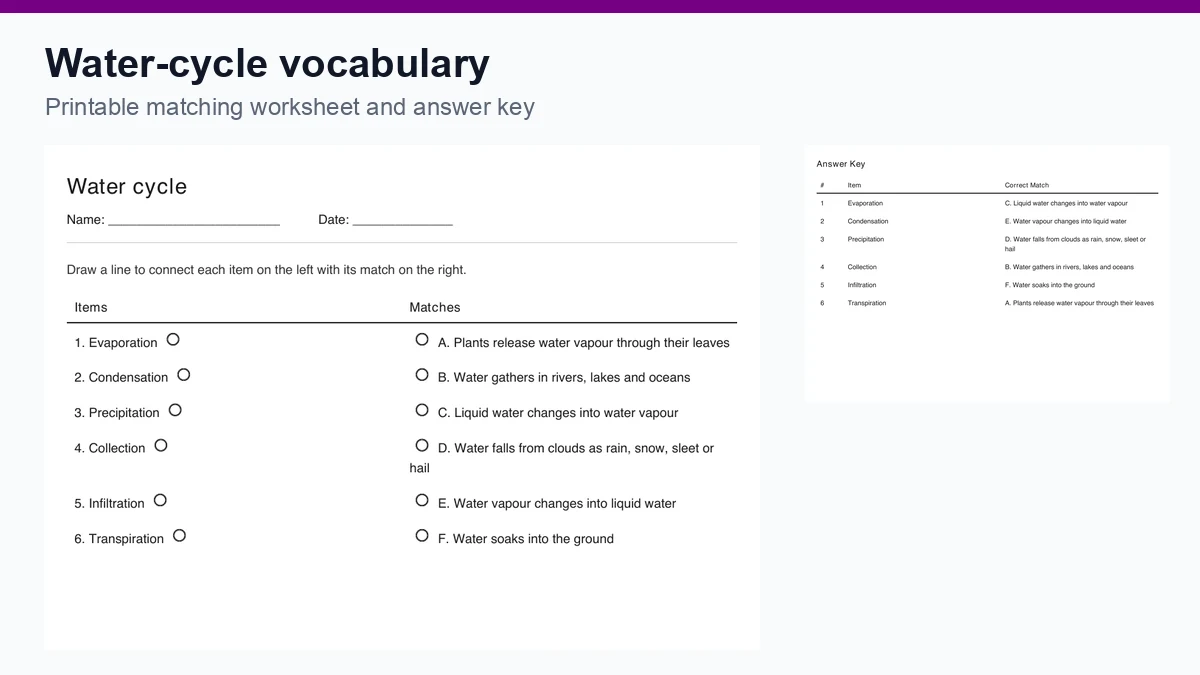
Use six science terms for a paper-based review, then ask students to explain the connections between the processes.
Use this activity after students have met the water-cycle vocabulary in a lesson, reading or diagram. The aim is to check which terms they can distinguish, then hear them explain the processes in their own words. A correct line on a worksheet is a useful starting point for that conversation; it does not, by itself, show that a student can explain the whole cycle.
Open the science example in the matching worksheet generator. The six pairs below are already entered. Change any wording to match your course, choose how students should answer and generate a PDF. Keep the answer key for checking rather than handing it out with the student page.
Six terms to start with
These are short working definitions for a review activity. They describe different movements or changes of water, not six compulsory steps that every drop follows in order. Collection refers to water gathering in rivers, lakes and oceans; it is not a change of state. The USGS water-cycle processes poster is a useful reference when discussing the processes with a diagram.
| Term | Definition |
|---|---|
| Evaporation | Liquid water changes into water vapour |
| Condensation | Water vapour changes into liquid water |
| Precipitation | Water falls from clouds as rain, snow, sleet or hail |
| Collection | Water gathers in rivers, lakes and oceans |
| Infiltration | Water soaks into the ground |
| Transpiration | Plants release water vapour through their leaves |
First round: match, then explain
Give students the worksheet with the definitions shuffled. Ask them to work on their own first and mark one pair they are unsure about. Once they have made their choices, let them compare that pair with a partner. Ask for the words in the definition that support the answer, rather than just the answer letter.
Bring evaporation and condensation together for the discussion: which direction does the change of state go in each case? Then compare infiltration and collection. Water entering soil is different from water gathering in a lake. If a student pairs these incorrectly, use a familiar example, such as rain falling on a lawn beside a paved path, and ask where the water might go.
Pick the paper format for the task
Draw Lines gives each student one sheet on which to connect the terms and definitions. Write the Match uses numbered items and a lettered word bank, which is convenient when you want to collect a short written response. Both formats still show the possible answers: neither is a test of recall without clues.
For paired work, choose Cut & Match and print the cards. Ask students to arrange the matching cards on a desk before explaining a connection between two terms. If cards are likely to be reused, print on suitable thicker paper within your printer’s limits. Review the generated PDF first; the preview shows the layout but does not show exact page breaks.
A follow-up without the answer choices
After checking the worksheet, cover the definitions and ask students to explain two terms without looking back. One prompt might be: “How does water leave a plant and reach the air?” Another is: “What changes when water vapour forms droplets?” Students can answer in a sentence or add labelled arrows to a diagram. This changes the task from choosing a supplied definition to producing an explanation.
For a later lesson, return to the same terms with a different question. Ask students to describe two possible routes taken by rainwater after it reaches the ground. Do not require a single six-step sequence: water can follow different paths through the system. Use the responses to decide which terms need another example or discussion.
Adapt the pairs before printing
Keep each definition specific enough to identify one term. If several answers say only “water moves,” the task becomes a guessing exercise. Use the vocabulary your class has been taught, and check whether any translation or specialist term needs a brief explanation. The sample is a starting list, not a claim to cover a particular exam board or curriculum.
The same editor also has a literary-devices example, where students can justify each match by pointing to words in a sentence, and a Spanish–English vocabulary set. For a list drawn from your own reading passage, the vocabulary extractor can help you identify terms; review their meanings before copying pairs into the worksheet.
Keep the materials you want to reuse
Your edits remain in the current page while you work, but they are not saved after you close or reload it. Copy a custom pair list to a spreadsheet or text file before leaving. Download the PDF promptly, because generated files are temporary. Print or share the downloaded file; do not rely on its temporary download address for a future lesson.
You can generate versions A, B and C in one request. Each is shuffled independently, so compare its own answer key with that version. Random shuffling can leave some answers in the same positions, and the on-screen preview may differ from the final PDF. Keep student names and other personal details out of the pair list: the subject terms are all this activity needs.
 This article is about
Matching Worksheet Generator
Open the tool