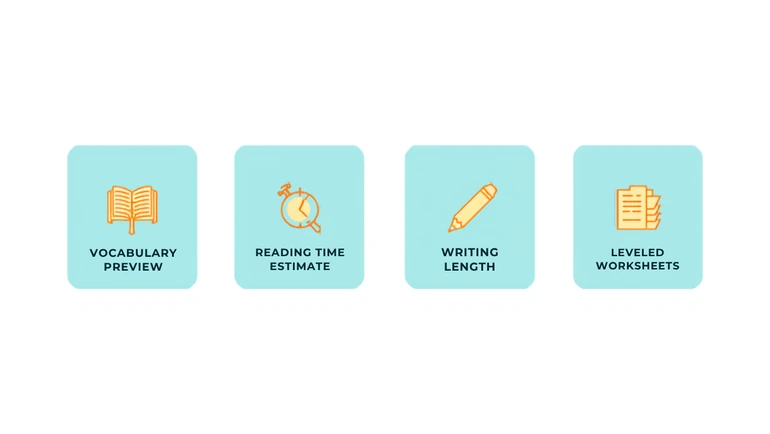
Tools for the language-support layer of a lesson -- vocabulary preview, realistic reading time, and leveled practice material.
Where a Language Learner's Lesson Actually Gets Harder
A reading assignment on photosynthesis is the same reading assignment whether or not a student is still building English fluency — the science doesn't change. What changes is a layer underneath the content: how many unfamiliar words stand between the student and the meaning, how long the same page actually takes to get through, and whether a shorter, simpler piece of writing back represents real understanding or a language gap. A lesson plan built around a native-speaking class quietly gets a few of these assumptions wrong for a language learner, and none of them are obvious until a student is already stuck.
Three of those assumptions come up constantly enough to be worth naming directly, along with what actually corrects for each one.
Assumption One: A Reading Takes as Long as It Would for a Fluent Reader
A time estimate built around fluent, native-speaker pacing doesn't hold for a student still building reading speed in a second language — and treating it as if it does means a "twenty-minute reading" can eat most of the period for exactly the students who most need the rest of the lesson. The Reading Time Calculator estimates reading time from a words-per-minute figure that's actually adjustable, not fixed — the default is 200 words per minute, but the field accepts anywhere from 50 to 800. Lowering it before generating an estimate for a language-learner group models their real pace directly, instead of adding a rough buffer to a number built for someone else.
Vocabulary is usually the bigger blocker than raw speed, though. The Vocabulary Extractor pulls the key terms out of a text before it's assigned, as a plain word list, a word list with definitions, a set of flashcards, or the same words shown in example sentences. Running a reading through it ahead of time turns "which words will trip students up" from a guess made mid-lesson into something checked in advance.
Assumption Two: Shorter Writing Means Shallower Understanding
A brief, simple piece of writing from a language learner can reflect solid understanding of the content even when the sentences look basic next to a fluent classmate's — length and grammatical complexity track English proficiency as much as they track comprehension. A Word Counter doesn't know any of that on its own; it counts characters, words, and paragraphs and nothing else. What it's actually useful for here is letting a teacher set and communicate a length target explicitly — "aim for 80 to 120 words" — calibrated by the teacher to what's realistic for a given student, rather than judging a response against an unstated expectation built for a fluent writer.
Assumption Three: One Worksheet Fits Everyone in the Room
Adapting a worksheet by hand for every lesson, for every proficiency level in a class, is a real ongoing time cost that's easy to let slide when the week gets busy. The Worksheet Generator takes pasted text or an uploaded document and turns it into multiple-choice, fill-in-the-blank, or short-answer questions, exported as a printable PDF or DOCX. It also has a "Student Level" setting — School, College, or Professional — worth being precise about: that's a general content-complexity dial, not a language-proficiency scale built for ESL/EFL specifically. The real differentiation still comes from what text is fed in and which question types are picked, with the level setting as one coarse extra adjustment on top, not a substitute for a teacher's read on where a specific student actually is.
What This Doesn't Solve
None of these four tools assess a student's actual proficiency level, and none of them replace a teacher's judgment about a specific student's needs. They remove some of the repetitive setup work around reading time, vocabulary, length expectations, and worksheet formatting — the logistics layer, not the diagnosis. Knowing which student needs which adjustment is still, and will stay, a teacher's call.
What Correcting for Each Assumption Actually Looks Like
The same 800-word reading estimates at 4 minutes for a fluent reader at the 200-word-per-minute default, and 16 minutes at 50 words per minute for a student still building reading speed — the same text, a four-times difference in how much class time to actually plan around it.
A vocabulary preview for that same reading might pull out: photosynthesis — the process plants use to make energy from sunlight; chlorophyll — the substance that gives leaves their green color and absorbs light. Both pre-taught in two minutes before the reading starts, instead of surfacing mid-paragraph as a stall.
A length target stated plainly — "aim for 80 to 120 words" — checked against a student's draft with the word counter, gives a language learner a clear, achievable goal instead of an unstated expectation built for a fluent writer's sentence complexity.
Privacy and Safe Use
When uploading a text for vocabulary extraction or a worksheet, or pasting student writing to check a length target, use only material appropriate for that purpose — an assigned reading or a student's own submitted work, not someone else's private writing. Keep notes about a specific student's proficiency level or language background as a professional record, not something displayed to the class.
Frequently Asked Questions
How much should the reading-speed setting be lowered for a language learner?
There's no single correct number — it depends on the individual student or class. Treating the default 200 words-per-minute figure as a starting point and adjusting it based on how a specific group actually paces tends to work better than applying one fixed reduction to every text.
Should vocabulary always be pre-taught, or can it wait until students hit an unfamiliar word?
Pre-teaching the words most likely to cause trouble generally works better than addressing vocabulary only after a student stalls mid-text, since getting stuck on one unfamiliar word can block understanding of everything around it.
Does the Worksheet Generator's Student Level setting adjust for English proficiency specifically?
No — School, College, and Professional are general content-complexity tiers, not an ESL-calibrated scale. Real differentiation comes mainly from the text and question types chosen, with that setting as one additional, coarser adjustment.
Can these tools be used in a mixed class with both native speakers and language learners?
Yes — they work well for building a differentiated version of the same lesson: a lower reading-speed estimate and a pre-taught vocabulary list for language learners, with the rest of the class working from the same underlying material.
None of this replaces knowing a specific student's actual level — it just removes some of the repetitive setup that gets skipped when there isn't time to do it by hand for every lesson.