Build a one-page front page — masthead, headline, byline, body text, and a photo or text banner — for history reports, media literacy, and creative writing.
The Same Event, Written Two Ways
Ask a student to summarize an event and hand it in as a report, and most will write it the way they've always written a report: a title, then paragraphs in the order things happened, building up to whatever mattered most. Ask for the same content laid out as a newspaper front page instead, and the order of operations flips. A headline has to earn attention in a handful of words before anything else gets read. A caption has to describe what a photo shows without repeating the headline sitting above it. The body has to open with the most important fact, not build toward it. None of that is naturally how students write a report, which is exactly why forcing the front-page format is useful.
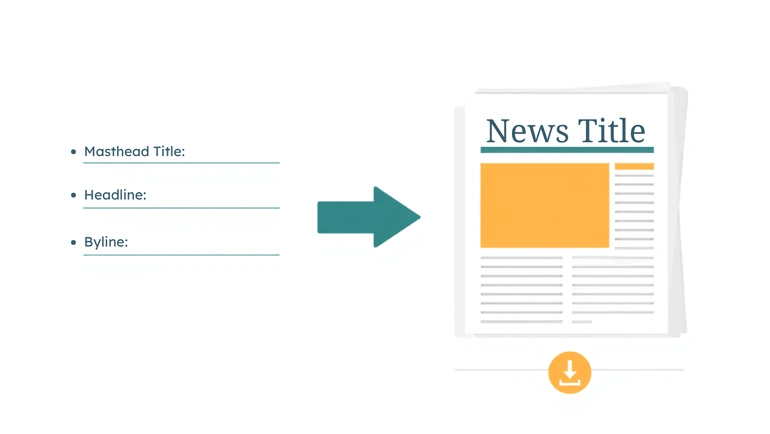
The Newspaper Generator builds that front page directly in the browser and exports it as a single image, so the writing constraint is the only thing standing between a student and a finished, presentable page. The layout has a fixed set of fields — a masthead title, a date line, a headline, a byline, and a body-text section, plus a toggle between two layouts: a photo with its own caption, or a text-only banner in its place. Nothing about the layout needs to be designed; the fields are the whole job.
The masthead title is capped at 16 characters, which is short enough that it forces real editing rather than accepting whatever the first draft happens to be. That's worth treating as a feature of the assignment, not an inconvenience — a few discarded attempts at a name or a paper title before one fits is closer to how an actual editor works than getting it right on the first try.
Where a Class Actually Uses This
A history class can report a battle, a discovery, or a political event as if it were happening that day, writing the headline the way a reporter on the scene would have — not with the hindsight a textbook summary carries. A media literacy unit can have students build a front page from a real current story instead of only analyzing ones that already exist, trying a few different headline phrasings to see how word choice shifts the story's apparent urgency. An English class can turn a novel's climax into its own front-page coverage, crediting a fictional reporter from inside the story, which asks for the same comprehension a standard essay response would but through a much more compressed, prioritized format. A set of front pages from the same unit, printed and hung side by side, also turns into a genuine classroom display rather than a stack of papers nobody sees again after grading.
Getting a Real Headline Out of a Short Field
The most common friction point is the masthead limit forcing an abbreviation nobody's happy with. It usually helps to draft two or three headline options in a scratch document first and pick the strongest one before typing into the field, rather than trying to compress a first-draft phrase down to fit. Students who default to a full-sentence title — "The Day Everything Changed at the Battle Of..." — get more out of the exercise if they're pushed to find the two or three words that actually carry the story, which is the entire skill a real headline is testing.
What It's Not Built For
This produces one front page, not a multi-page newspaper — a project that genuinely needs several linked pages is a better fit for a Presentation Slides Generator, and a written companion piece explaining the underlying research is better handled with a Worksheet Generator. The layout also doesn't check whether the story itself is accurate — for a history-based front page especially, it's still worth verifying dates, names, and claims against a real source before finalizing the text, since a polished layout can make an inaccurate claim look more authoritative than it is.
What that Battle of Gettysburg front page might settle on after a few discarded headline attempts:
- Masthead (16-char limit): GETTYSBURG FALLS
- Headline: Union Forces Repel Confederate Assault After Three Days of Fighting
- Byline: By a Correspondent Traveling With the Army of the Potomac
- Caption: Soldiers hold the line along Cemetery Ridge as the battle reaches its third day.
"GETTYSBURG FALLS" fits the masthead exactly at 16 characters — a full title like "The Battle of Gettysburg Today" would need trimming before it fits at all.
Privacy
The photo a student chooses is processed entirely in the browser and never leaves it — there's no upload step involved in building the page. For fictional, historical, or general class-topic front pages, no student data is involved at all. The one case worth a second thought is a genuine "school newspaper" style project covering real events at school — in that case, only use names and photos that students and staff are comfortable seeing shared publicly, and check with a supervising teacher before including a real photo of another student.
FAQ
Why is the masthead title limited to 16 characters?
It keeps the title short enough to read as a real newspaper name rather than a full sentence — the same constraint a real masthead has. Drafting a couple of options before settling on one usually gives a stronger result than trying to abbreviate a longer phrase down to fit.
Do I have to use a photo?
No — a text-only banner is available as an alternative layout when a photo isn't available or isn't appropriate for the story.
Does the date update automatically?
It starts pre-filled with today's date but can be edited to any date — useful for a historical piece or a fictional story set on a different day.
What format does the finished page download as?
A single image, saved with a .jpg file name, ready to print, project, or drop into a digital portfolio.
Is this only useful for older students?
It works across a wide range of grade levels — younger students can use it for a simple creative-writing exercise, and older students can push further into headline craft and media literacy technique.
The Format Does the Structural Work
A front page forces a kind of writing most classroom assignments don't ask for — short, prioritized, built to earn attention before a reader commits to the rest of the story. Whatever the source material — a real historical event, a novel's climax, or a class topic worth putting on display — the layout supplies the constraints. What a student still has to bring is the actual judgment call: knowing what matters most about the story, and saying it first.
 This article is about
Newspaper Generator for School Projects and Class Work
Open the tool
This article is about
Newspaper Generator for School Projects and Class Work
Open the tool