Practical seating routines for calmer classrooms, fair group work, better visibility, and fewer daily management problems
A teacher walks into class with a lesson ready, but the room is already working against the plan. Two close friends are talking before the starter activity begins. One student cannot see the board clearly from the back. Another student who needs quiet support is seated beside the busiest table. The lesson has not failed, but the seating arrangement has created extra work before teaching even starts.
Classroom seating is easy to underestimate because it looks like furniture management. In practice, it affects attention, movement, noise, fairness, confidence, collaboration, visibility, and the amount of time a teacher spends redirecting students.
A good seating plan does not solve every classroom problem. It will not replace strong routines, clear instructions, relationships, lesson quality, or student support. It can, however, remove predictable friction. When students can see, hear, move, work with the right partners, and understand where they belong, the class starts with fewer avoidable interruptions.
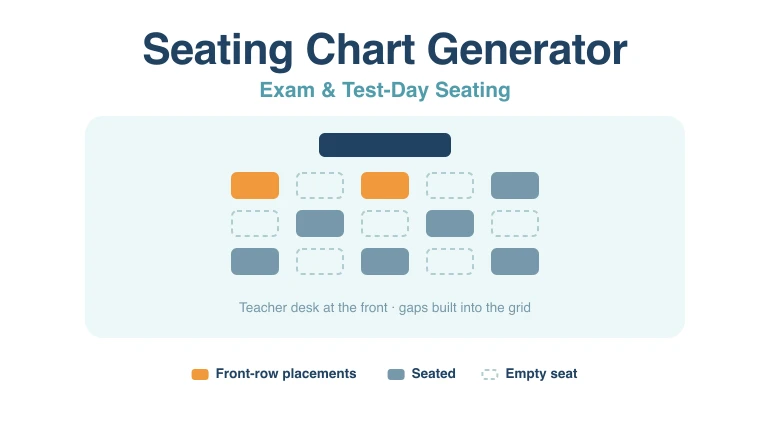
Teachers can plan seating on paper, in a spreadsheet, or with a tool such as the Seating Chart Generator. The tool helps with layout and placement, but the teacher still makes the professional decisions: who needs support, who works well together, who needs space, and how the seating plan fits the lesson.
Why Seating Plans Matter More Than They Seem
Classroom seating is more than a matter of keeping desks tidy. Research suggests that the arrangement of desks can influence students' attention and behavior, and that the best arrangement depends on the type of activity. A review by Rachel Wannarka and Kathy Ruhl found evidence that rows can support more appropriate behavior during individual tasks, while different arrangements may be better suited to other classroom activities.
Students do not experience a classroom as a neutral grid of desks. They experience it as a place where they can be seen, ignored, distracted, supported, included, or isolated. A seat can affect whether a student asks for help, joins a discussion, reads the board, hears instructions, or becomes involved in side conversations.
Teachers often notice seating problems only after they interrupt learning. A pair talks through instructions. A group becomes too dependent on one student. A quiet learner disappears at the back. A student with a hearing or vision need struggles silently. A seating plan can prevent some of those patterns before they repeat every day.
The aim is not to control every interaction. Students need relationships, collaboration, and trust. The aim is to arrange the room so that learning is easier than distraction.
Seating should also remain flexible. A plan that works during independent writing may not work during science practical work, drama, debate, reading circles, or group projects. Teachers may need several seating modes rather than one permanent map.
Start With The Lesson Purpose
The best seating plan begins with the task, not the desks. A discussion lesson needs students to see and hear one another. A test needs space and reduced distraction. A project lesson may need groups with mixed strengths. A reading lesson may need quiet focus and easy teacher access.
Before arranging seats, ask: What will students do most during this lesson? Listen, write, discuss, practise, build, read, present, solve problems, or move between stations?
If students will mainly listen and take notes, visibility and attention matter most. If students will work in pairs, partner choice matters. If students will rotate through stations, movement paths and table labels become important.
This simple question prevents a common mistake: using the same seating arrangement for every activity, then blaming students when the arrangement does not match the task.
Real Classroom Seating Scenarios
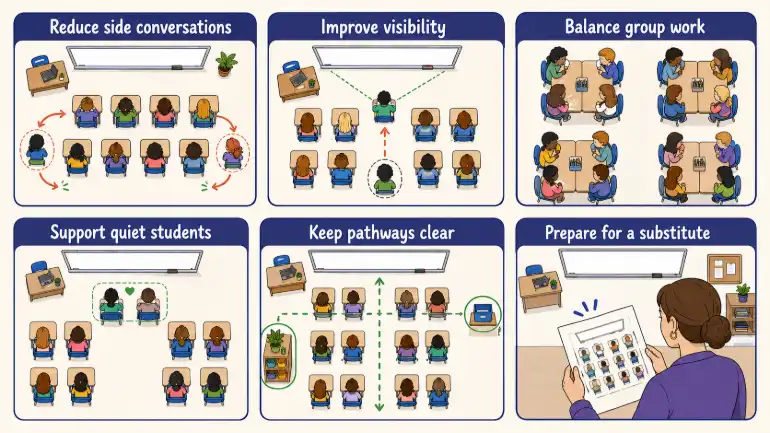
1. Reducing Repeated Side Conversations
Situation: Two students are capable learners but distract one another during instructions.
Problem: Moving them only after several warnings turns seating into a punishment and creates tension.
Better approach: Place them in different areas before the lesson begins and give each a clear learning partner nearby. Avoid making the move dramatic. The plan should feel normal, not personal.
Result: The teacher spends less time interrupting the lesson, and both students have a better chance to focus without losing social connection completely.
2. Supporting Students Who Need Better Visibility
Situation: A student misses instructions because they cannot clearly see the board or demonstration area.
Problem: The student may appear inattentive when the real issue is visibility.
Better approach: Place students with vision, hearing, attention, or processing needs where they can access instruction easily. Check glare, board angle, projector brightness, and distance.
Result: The student receives the lesson more clearly, and the teacher avoids misreading an access issue as behavior.
3. Planning Fair Group Work
Situation: A group project starts, and students immediately choose friends.
Problem: Some groups become noisy, some lack confidence, and some depend on one high-performing student to do most of the work.
Better approach: Create groups with a mix of strengths, confidence levels, and working styles. Consider who can encourage discussion, who needs a calm partner, and who should not carry the whole task alone.
Result: Group work becomes more balanced. Students still need roles and instructions, but the seating plan no longer creates predictable problems from the start.
4. Helping Quiet Students Participate
Situation: A quiet student sits at the edge of the room and rarely contributes.
Problem: The student may understand the lesson but receive fewer chances to speak, ask questions, or work with supportive peers.
Better approach: Seat the student near a calm, reliable partner and within easy teacher contact. Use low-pressure discussion routines before asking for whole-class answers.
Result: Participation becomes more realistic. The seating plan supports confidence instead of forcing sudden public performance.
5. Managing Movement In A Busy Room
Situation: Students need to collect materials, submit work, and move to group stations.
Problem: Narrow paths cause crowding, delays, and off-task talk.
Better approach: Plan walking routes, supply points, and teacher access before the lesson. Avoid placing high-traffic areas beside students who struggle with distraction.
Result: Movement becomes part of the lesson routine rather than a repeated interruption.
6. Preparing For A Substitute Teacher
Situation: A substitute teacher covers the class and does not know student names or routines.
Problem: Without a clear seating chart, attendance, support, behavior expectations, and group work become harder to manage.
Better approach: Keep a simple, readable seating plan with student names, necessary support notes, and any important classroom routines. Sensitive information should be included only when appropriate and necessary.
Result: The substitute teacher can identify students more easily and maintain the normal classroom structure.
How This Fits Into A Real Teacher Workflow
- Start with the learning task. Decide whether students need focus, discussion, collaboration, testing conditions, or movement.
- List classroom constraints. Note board visibility, doors, windows, power outlets, walkways, and teacher access.
- Review student needs. Consider vision, hearing, attention, confidence, language support, behavior patterns, and peer relationships.
- Choose the layout. Use rows, pairs, groups, U-shape, stations, or another arrangement that fits the task.
- Place priority seats first. Seat students with access needs before filling the remaining spaces.
- Balance groups carefully. Avoid placing all confident speakers or all quiet learners together unless the task requires it.
- Prepare the chart. Use a clear seating map that can be read quickly.
- Introduce the plan calmly. Explain the learning reason without discussing private student details.
- Watch the first lesson. Notice noise, visibility, access, and movement problems.
- Adjust without drama. Move seats when needed and explain changes as part of improving the room for learning.
Common Problems This Solves
- Friends distract one another during instructions.
- Quiet students are overlooked at the edge of the room.
- Students cannot see the board or demonstration clearly.
- Group work becomes unfair or unbalanced.
- High-traffic areas create avoidable distraction.
- A substitute teacher cannot identify students quickly.
- Classroom movement takes too long.
- One student carries the whole group task.
- Support needs are not reflected in the room layout.
- The same seating plan is used for every activity.
Seating With A Plan Compared With Random Placement
| Classroom need | Planned seating | Unplanned seating |
|---|---|---|
| Visibility | Students who need clear access are placed intentionally. | Some students may struggle silently. |
| Behavior support | Predictable distractions can be reduced early. | The teacher reacts after problems begin. |
| Group work | Strengths and support needs can be balanced. | Students may cluster by friendship only. |
| Teacher movement | The teacher can reach more students quickly. | Some desks become hard to access. |
| Substitute cover | The class map supports attendance and routines. | The substitute starts with less information. |
| Student confidence | Partners and positions can support participation. | Quiet learners may remain invisible. |
Quality And Trust In Seating Decisions
A seating plan should be based on learning needs, not labels or assumptions. Teachers should be careful not to place students permanently according to reputation, ability, friendship group, or behavior history without reviewing whether the arrangement still helps.
Students can change. A plan that was useful in September may feel unfair or unnecessary later in the year. Review seating after assessments, group projects, new students, behavior changes, and classroom layout changes.
Do not use seating to publicly shame a student. If a move is needed because of behavior, keep the explanation brief and private where possible. The class does not need a public announcement about why one student moved.
For students with documented needs, follow school guidance and support plans. Seating can be part of access, but it should not replace proper accommodations.
Privacy And Student Information
Seating charts often contain student names and sometimes notes about support needs. Treat them as classroom records, not public posters.
A printed seating plan for a substitute teacher should include only information needed to run the lesson safely and respectfully. Avoid unnecessary details about grades, behavior history, medical information, or family circumstances.
If a seating chart is displayed on a screen, check whether visitors, other classes, or online meeting participants can see it. Student names should not be shared more widely than necessary.
When saving or downloading seating charts, use secure school storage and clear filenames. Do not upload charts containing full student names to public folders or personal social accounts.
Helpful Seating Plan Tips
Keep the first version simple. A seating chart with too many hidden rules can become difficult to maintain. Start with the most important needs: visibility, access, known distractions, and group balance.
Leave room for teacher movement. If the teacher cannot reach a student without stepping over bags or squeezing between desks, support becomes slower.
Think about noise before it starts. Doorways, windows, supply shelves, and high-traffic paths can increase distraction. Place students thoughtfully around those areas.
Use temporary layouts for special lessons. A debate, reading circle, quiz, practical activity, and independent writing lesson may not need the same arrangement.
Review the chart after using it. The best seating plans are adjusted from real classroom evidence, not created once and forgotten.
Common Mistakes To Avoid
- Using seating only as a punishment.
- Ignoring visibility and hearing needs.
- Putting all high-support students in one area.
- Letting friendship groups decide every seat.
- Creating groups without clear roles.
- Blocking teacher movement paths.
- Displaying sensitive seating notes publicly.
- Keeping the same chart after it stops working.
- Assuming quiet students do not need support.
- Changing seats without explaining the learning purpose.
Classroom seating arrangement examples
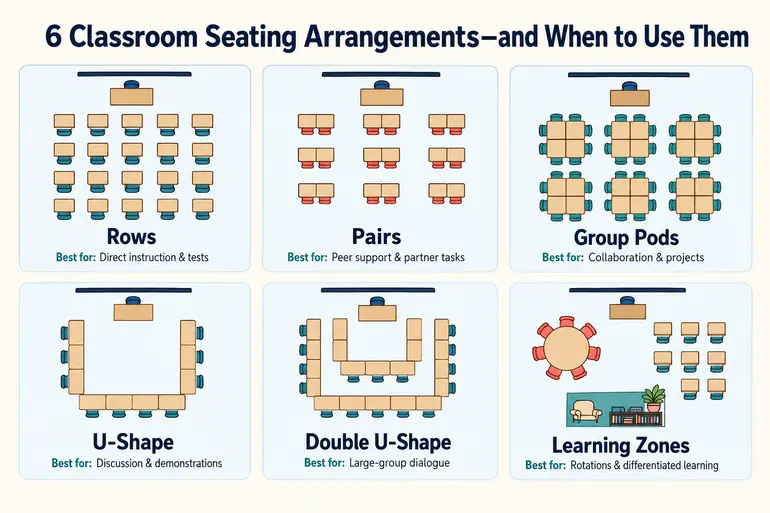
- Rows: seating all students in rows which is best for tests or direct instructions.
- Pairs: seating all students in a pair of 2 which is best for partner tasks and peer support.
- Group pods: seating all students in groups which is best for collaboration & projects.
- U-shape: seating all students in U-shape which is best for demonstrations and discussion.
- Double U-shape: seating all students in U-shape and inside it another U-shape seating, which is best for lage group dialogue
- Learning zones: seating all students into separate areas for different activities. Where students can rotate between zones during the lesson and it is best for mix activities.
Frequently Asked Questions
How often should teachers change seating plans?
There is no fixed rule. Change the plan when the learning task, class behavior, student needs, or classroom layout changes. Some classes need frequent adjustments, while others work well with stable routines.
Should students choose their own seats?
Sometimes. Student choice can work during low-risk activities or when routines are strong. For focused lessons, assessments, and sensitive group work, teacher planning may be better.
What is the best classroom seating layout?
The best layout depends on the lesson. Rows can support focus, groups can support collaboration, and U-shapes can support discussion. The task should guide the layout.
How can seating help quiet students?
Place quiet students near supportive peers and within easy teacher contact. Pair seating with low-pressure routines such as partner rehearsal before whole-class responses.
Can seating improve behavior?
It can reduce predictable distractions and improve teacher access, but it should work alongside clear routines, relationships, and lesson structure.
Should seating charts include student support notes?
Only when necessary and appropriate. Keep notes respectful, brief, and private. Follow school policy when sharing information with substitutes or support staff.
How can teachers make group seating fair?
Balance confidence, subject strengths, working habits, and support needs. Avoid letting one student carry the group or placing several distracting combinations together.
Can a seating chart help substitute teachers?
Yes. A clear chart helps with names, attendance, routines, and classroom confidence. Include only the information needed for the lesson.
How should teachers handle complaints about seat changes?
Explain the learning reason calmly and avoid public debates. Review the arrangement after students have had time to try it.
Can digital seating charts save time?
Yes. A digital chart can be edited, printed, reused, and adjusted more quickly than redrawing the room every time.
Final Thought
A seating plan is not just a map of desks. It is part of classroom design. It can support attention, access, fairness, movement, confidence, and smoother routines.
The most useful plans are practical rather than perfect. They begin with the lesson purpose, respect student needs, protect privacy, and change when evidence shows that a better arrangement is needed.
When teachers plan seating thoughtfully, they reduce small daily obstacles. That gives more room for instruction, discussion, support, and the kind of classroom work that matters most.
 This article is about
Seating Chart Generator
Open the tool
This article is about
Seating Chart Generator
Open the tool