Practical lesson planning habits that help busy teachers prepare clear, useful lessons without spending the whole evening rewriting plans.
Lesson planning can easily take over a teacher’s evening. A teacher sits down after school intending to plan tomorrow’s lesson quickly, but the work spreads. There are standards to check, slides to adjust, examples to prepare, student needs to consider, worksheets to find, and a backup activity to keep in mind in case the class finishes early or gets stuck.
The problem is not that teachers do not know how to plan. Most teachers know their subject, their students, and the shape of a good lesson. The problem is that planning can become too wide. Instead of deciding what students need to learn and how they will practise it, the teacher ends up polishing small details that may not matter once real students enter the room.
A better lesson plan does not have to be longer. In many classrooms, the strongest plans are simple, focused, and easy to teach from. They answer the practical questions a teacher actually needs during the lesson: What should students understand by the end? How will I explain it? What will students do with it? How will I know who needs help? What will I do if the lesson moves faster or slower than expected?
The 20-minute planning approach is not about rushing. It is about giving each part of the plan a clear job. When teachers know what to decide first, what to leave simple, and what can be reused, lesson planning becomes lighter and more useful.
Why Lesson Planning Takes Too Long
Many lesson plans become slow because teachers begin with activities instead of learning. It is tempting to search for a worksheet, video, game, or project first. Those resources can be helpful, but they should not lead the lesson. If the activity comes first, the teacher may spend extra time trying to make it fit the objective.
Planning also takes longer when the lesson tries to do too much. A single class period may include a warm-up, review, new vocabulary, direct teaching, group work, independent practice, a discussion, a quiz, and an exit ticket. That may look complete on paper, but it can feel rushed in the room. Students need time to think, make mistakes, ask questions, and practise.
Another reason planning stretches is that teachers often plan for an ideal class rather than the class they actually have. Real classrooms include absent students, unfinished homework, mixed reading levels, limited attention, missing supplies, and interruptions. A practical plan makes room for these realities.
The 20-Minute Lesson Planning Frame
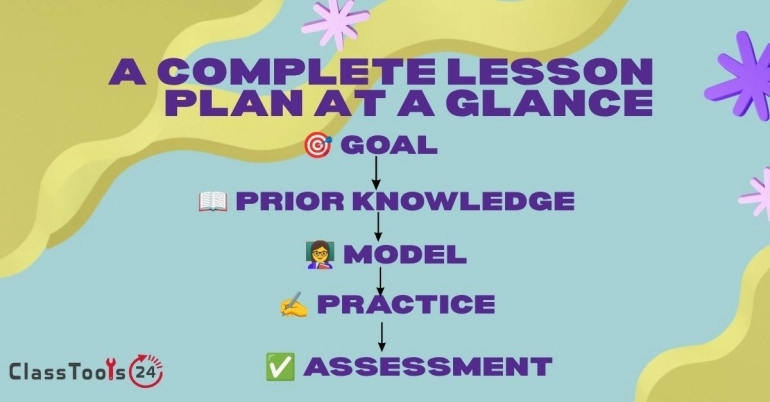
A 20-minute lesson plan works best when the teacher follows a fixed order. The order matters because each decision supports the next one. If the learning goal is clear, the explanation becomes easier. If the explanation is clear, practice can be chosen more carefully. If practice is clear, checking understanding becomes simpler.
Here is a realistic structure:
- Choose the learning goal.
- Decide what students already know.
- Plan the explanation or model.
- Choose one main practice task.
- Add one check for understanding.
- Prepare support and extension options.
- Write the lesson flow in simple teacher language.
This frame keeps the teacher focused. It also prevents the plan from becoming a collection of unrelated tasks.
Minute 1-3: Choose One Clear Learning Goal
Start by writing the learning goal in plain language. Avoid writing a sentence that sounds impressive but does not guide teaching. A useful goal tells the teacher exactly what students should be able to do.
For example, instead of writing, “Students will understand persuasive writing techniques,” write, “Students will identify a claim, reason, and evidence in a short persuasive paragraph.” The second goal is easier to teach, practise, and assess.
For math, instead of “Students will learn fractions,” write, “Students will compare two fractions with the same denominator using models and symbols.” For reading, instead of “Students will improve comprehension,” write, “Students will use two details from the text to explain a character’s choice.”
If the goal cannot be checked by the end of the lesson, it may be too broad. A 20-minute planning habit begins with narrowing the target.
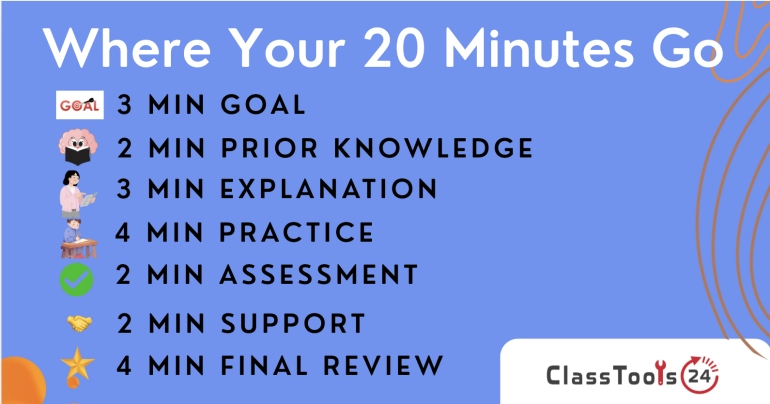
Minute 4-5: Think About What Students Already Know
Before planning new instruction, pause and ask: What do students already know that connects to this lesson? What might they confuse? What vocabulary could slow them down?
This step saves time later. If students are learning how to write topic sentences, they may already know what a paragraph is. They may not know how a topic sentence is different from a title. If students are solving two-step word problems, they may understand addition and subtraction but struggle to decide which operation comes first.
Write one quick note in the plan: “Students may confuse main idea with detail,” or “Review denominator before comparing fractions.” This note helps the teacher begin the lesson at the right place.
Minute 6-8: Plan The Explanation
A good explanation does not need to be long. It needs to be clear. Decide how you will introduce the idea in three to five minutes. Choose one example that is simple enough for students to follow and one example that shows the common mistake.
For example, in a grammar lesson about commas in a list, show a correct sentence and a sentence missing commas. In a science lesson about habitats, show one clear example and one non-example. In a coding lesson, show one working line and one broken line.
Teachers often spend too long preparing many examples. One strong model is usually better than five rushed examples. Students need to see the thinking process, not just the answer.
Minute 9-12: Choose The Main Practice Task
The practice task is where students actually learn. Choose one main task that matches the learning goal. If the goal is to identify evidence, students should identify evidence. If the goal is to solve equations, students should solve equations. If the goal is to compare sources, students should compare sources.
A common planning mistake is choosing a fun activity that does not give enough practice. A colorful worksheet, group poster, or online game may look engaging, but it must still ask students to do the target skill repeatedly enough to improve.
Keep the first practice task short and focused. Students can work with a partner, complete five questions, annotate a paragraph, sort cards, solve two problems on mini whiteboards, or explain one example in writing. The task should give the teacher something to observe.
Minute 13-14: Add A Check For Understanding
Every lesson needs one quick check. This does not have to be a formal quiz. It can be an exit ticket, a thumbs signal, a one-question response, a mini whiteboard answer, a sentence frame, or a quick sort.
The check should connect directly to the learning goal. If the goal was to identify claim, reason, and evidence, the exit ticket should ask students to label those parts. If the goal was to compare fractions, the check should ask students to compare two fractions and explain how they know.
A good check helps the teacher decide the next step. If most students understand, move forward. If many students miss the same point, reteach it. If only a few students struggle, plan a small group.
Minute 15-16: Prepare Support And Extension
Planning for student differences does not always mean creating three separate lessons. Often, it means preparing small adjustments.
Support may include a word bank, sentence starter, worked example, partner option, visual model, or reduced number of questions. Extension may include a challenge question, deeper explanation prompt, error analysis task, or request for students to create their own example.
Write one support and one extension into the plan. This keeps the teacher ready without creating unnecessary work.
Minute 17-20: Write The Flow
Now write the lesson in a simple sequence. Use teacher-friendly language, not formal paragraphs. A practical lesson flow might look like this:
- Warm-up: review yesterday’s skill with two quick questions.
- Goal: students will identify claim, reason, and evidence.
- Model: read one paragraph and label each part.
- Guided practice: students label a second paragraph with a partner.
- Independent practice: students label a short paragraph alone.
- Check: exit ticket with one new paragraph.
- Support: provide sentence starter and highlighted paragraph.
- Extension: students write their own claim, reason, and evidence.
This is enough to teach from. It gives the teacher direction without trapping the lesson in too many details.
What To Stop Overplanning
Teachers often spend too much time writing perfect scripts. A few key phrases can help, but a full script is rarely needed unless the teacher is new to the content or preparing for a formal observation. Instead, write the main question, model example, and common mistake.
Teachers can also stop overdesigning materials. A simple table, short paragraph, or five-question practice set can be more effective than a heavily decorated worksheet. Students usually benefit more from clear instructions and useful feedback than from polished formatting.
Another area to simplify is warm-ups. A warm-up should prepare students for the lesson, not become a separate lesson. One review question, one image prompt, one vocabulary match, or one quick problem is enough.
Planning For Real Classroom Problems
Efficient planning does not ignore classroom problems. It plans for the most common ones without making the teacher prepare for every possible situation.
If students finish early, have one extension prompt ready. If students struggle, have one simpler example ready. If technology fails, know the non-digital version of the task. If group work gets noisy, prepare a clear time limit and role. If students do not understand the directions, model the first step before releasing them.
Small backup decisions save time and stress. They also help the lesson keep moving when reality does not match the plan.
Reusable Lesson Planning Templates
A reusable structure saves more time than starting fresh each day. Teachers can keep a simple template with the same headings:
- Learning goal
- Prior knowledge
- Model example
- Practice task
- Check for understanding
- Support
- Extension
- Materials
Using the same template every time reduces decision fatigue. The teacher does not have to decide how to plan. They only have to decide what the lesson needs.
Example: A 20-Minute Reading Lesson Plan
Learning goal: Students will use two text details to explain a character’s feeling.
Prior knowledge: Students know what a character is and can identify feelings. They may need help choosing evidence from the text.
Model: Read a short paragraph. Think aloud: “The character says she does not want to go inside, and she looks at the ground. Those details show she may feel nervous.”
Practice: Students read a second paragraph with a partner and underline two details that show feeling.
Check: Students write one sentence: “The character feels ___ because ___ and ___.”
Support: Provide a feelings word bank.
Extension: Ask students to explain how the feeling changes from the beginning to the end.
Example: A 20-Minute Math Lesson Plan
Learning goal: Students will solve two-step addition and subtraction word problems.
Prior knowledge: Students can add and subtract within the required range. They may rush and solve only one step.
Model: Read one problem and circle the question. Underline the numbers. Ask, “What do we need to find first?” Solve step one, then step two.
Practice: Students solve three problems. After each problem, they write “Step 1” and “Step 2” beside their work.
Check: One exit problem with space for both steps.
Support: Provide a problem-solving checklist.
Extension: Students write their own two-step problem for a partner.
How To Know If The Plan Is Strong Enough
A lesson plan is strong enough if another teacher could understand the goal, main activity, and check for understanding quickly. It does not need to explain every word the teacher will say.
Ask these questions before finishing:
- Can I explain the learning goal in one sentence?
- Does the practice match the goal?
- Will I know by the end who understood?
- Do I have one support for students who struggle?
- Do I have one extension for students who are ready?
- Are the materials realistic for the time I have?
If the answer is yes, the plan is ready.
Final Thought
Efficient lesson planning is not about caring less. It is about protecting teacher energy for the parts of teaching that matter most: explaining clearly, listening to students, responding to mistakes, and adjusting in the moment.
A twenty-minute plan can be thoughtful, practical, and classroom-ready. When teachers focus on the goal, model, practice, check, support, and extension, they spend less time filling pages and more time preparing lessons students can actually learn from.