
Convert images for assignments, Google Classroom uploads, worksheets, presentations, portfolios, and school websites without complicated software.
Image Conversion For Real School Problems
A student finishes a science project, takes a photo on an iPhone, and tries to upload it to the school portal. The work is ready, but the platform rejects the image because the format is not supported. A teacher prepares a worksheet with screenshots, but one image will not insert properly into the document. A student builds a portfolio page, but the image format does not display correctly in the browser.
These are small file problems, but they interrupt real learning work. The image is useful. The assignment is ready. The lesson material is prepared. The only issue is that the image format does not fit the place where it needs to go.
This Image Converter helps teachers, students, and school teams change images into a format that works for assignments, forms, presentations, classroom resources, websites, digital learning platforms, and online submissions. Instead of recreating the file or retaking the photo, users can convert the image and continue with the task.
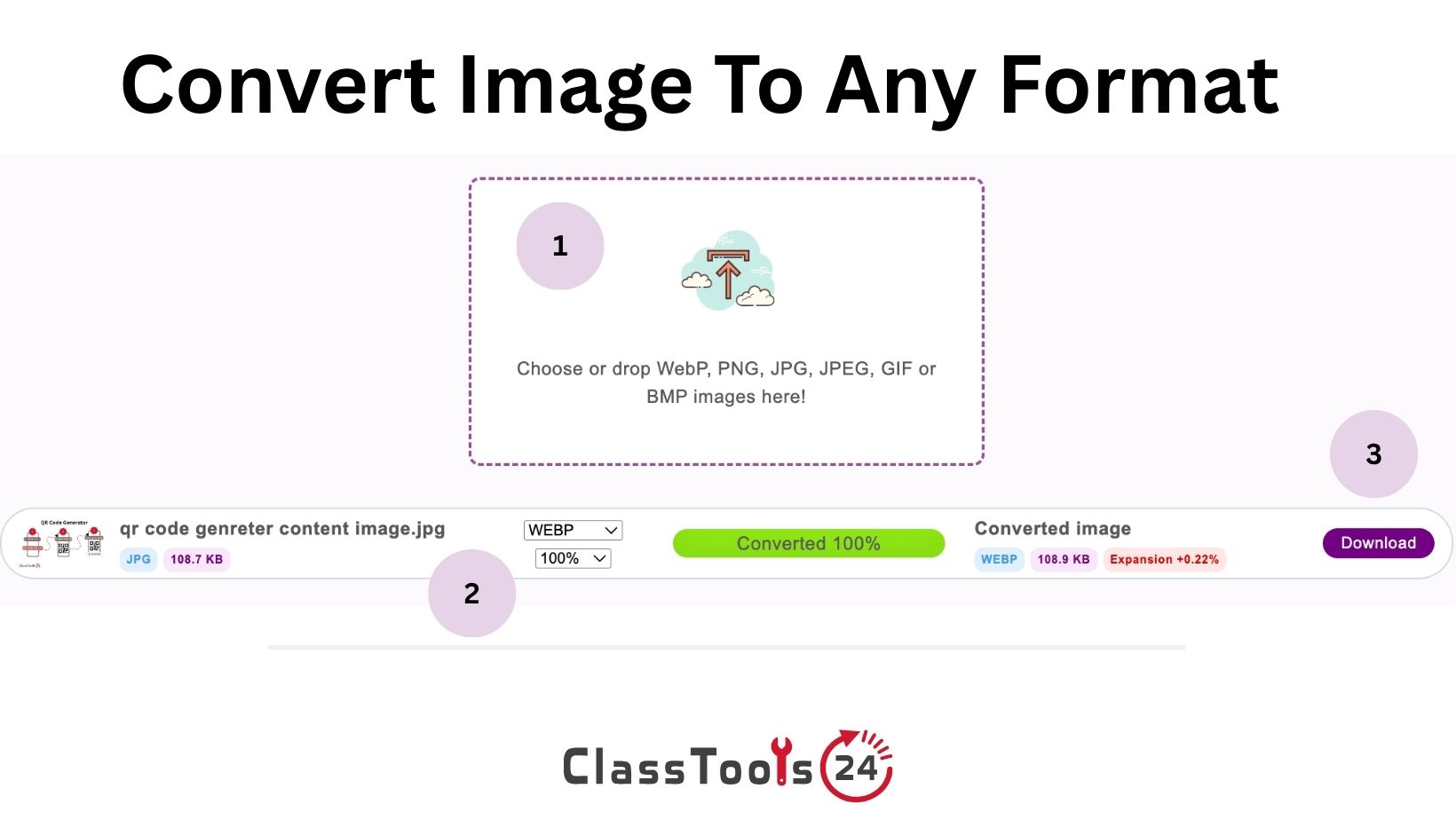
How To Use The Image Converter
- Upload the image you want to convert.
- Select the output format required for your assignment, form, slide, document, or website.
- Convert the image.
- Download the converted file and open it once to confirm it looks correct.
This quick check matters. If the image includes written work, labels, charts, screenshots, or project evidence, make sure those details remain clear before submitting or publishing the file.
Why Image Format Matters In School Work
Image format affects whether a file can be uploaded, opened, edited, displayed, or shared. A photo may look fine on a phone but fail in an LMS upload. A screenshot may look sharp but be saved in a format that does not work well in a worksheet. A website may support one format but not another. In classroom technology, format compatibility can decide whether the work moves forward smoothly or gets stuck at the upload step.
Teachers and students do not need to know every technical detail behind image formats. They only need to know which format fits the job. A JPG is usually practical for photos. A PNG is often better for screenshots and images with text. WEBP can be useful for websites because it can keep images lighter. SVG works well for simple graphics and icons. GIF is commonly used for simple animations.
Common Image Formats Explained
| Format | Best Use | School Example |
|---|---|---|
| JPG | Photos and general image sharing | Project photos, event images, assignment pictures |
| PNG | Screenshots, sharp text, diagrams, transparent images | Worksheet screenshots, labeled diagrams, app examples |
| WEBP | Websites and faster-loading online images | Class pages, school blogs, student portfolio websites |
| SVG | Simple graphics, icons, and scalable visuals | Logos, badges, simple classroom graphics |
| GIF | Simple animations or short visual loops | Basic animated examples, classroom demonstration visuals |
Related use cases
Image Converter Use Cases for Students, Teachers, and Beginner Developers
Explore practical Image Converter use cases for students, teachers, and beginner developers. Learn how image conversion helps fix unsupported file formats, prepare assignment uploads, build ...
Read use case
Image Converter Use Cases for Students, Teachers, and Beginner Developers
Learn practical Image Converter use cases for students, teachers, and beginner developers. Fix unsupported image formats, prepare classroom uploads, improve worksheets, publish portfolios, a...
Read use caseScience Fair Submission Example
A student photographs a science fair model at home. The photo opens perfectly on the phone, but when the student uploads it to the school submission form, the form rejects the file type. The deadline is close, and the student does not want to rebuild the submission.
In this situation, the student can use the Image Converter to change the photo into a more accepted format such as JPG or PNG. After conversion, the student should open the file and check that the model, labels, and written explanation are still visible. If the image is too large after conversion, the Image Compressor can reduce the file size before upload.
This is a real classroom workflow: fix the format, check the evidence, reduce the size if needed, and submit the project without losing time.
Classroom Newsletter Example
A teacher prepares a weekly classroom newsletter with photos from a group activity, screenshots of student resources, and a reminder about upcoming assignments. Some images come from a phone, some from a browser, and some from downloaded files. When placed together, the newsletter may not handle every format cleanly.
Before finalizing the newsletter, the teacher can convert images into consistent formats. Photos can become JPG files. Screenshots with text can become PNG files. Images for a classroom web page can be prepared as WEBP if the site supports it. This makes the newsletter easier to manage and helps avoid broken or unsupported images.
If the newsletter will be emailed or uploaded to a class page, compression may also help. A lighter file is easier for parents and students to open on phones, tablets, and slower connections.
Student Portfolio Example
A student portfolio may include artwork, screenshots, scanned pages, project photos, certificates, and website images. These files often come from different devices and apps, so the formats may not match. A portfolio that uses incompatible or oversized images can load slowly or show broken previews.
Image conversion helps the student standardize files before publishing. Photos can be converted into JPG. Screenshots and diagrams can stay sharp as PNG. Website images can be prepared in a format that loads efficiently. This makes the portfolio look more organized and easier for teachers, classmates, or reviewers to open.
Students also learn an important digital learning habit: preparing media for the audience. A good portfolio is not only about collecting work. It is about presenting work clearly.
Common Image Problems Students Face
- iPhone photos saved in HEIC format do not upload to a school platform.
- A classroom form rejects an unsupported file type.
- A screenshot is too large or saved in the wrong format for an assignment.
- A scanned worksheet becomes blurry after being changed incorrectly.
- A student portfolio page shows a broken image preview.
- A Google Classroom or LMS upload accepts only certain image formats.
- A presentation image looks fine on one device but does not display correctly on another.
- A school website image loads slowly because the file format and size were not prepared properly.
How Teachers Can Use The Image Converter
Teachers often collect images from different sources. A worksheet may include diagrams, classroom photos, screenshots, scanned pages, or images downloaded from approved educational resources. These files may come in different formats, and not every format works well in every document or platform.
With the Image Converter, teachers can prepare images before adding them to worksheets, slides, newsletters, classroom pages, printable resources, or online learning materials. If a file format is not accepted by a platform, converting it can solve the issue without rebuilding the material from scratch.
This tool also fits naturally with other classroom tools. A teacher may convert images first, then use the Image Compressor to reduce file size, or use the Image Resizer to adjust dimensions. If several images need to become one document, the JPG to PDF Converter or PNG to PDF Converter can help complete the workflow.
How Students Can Use Image Conversion
Students often run into file-format problems when submitting assignments. A project image may be saved in a format the school platform does not accept. A screenshot may need to be converted before it can be added to a presentation. A portfolio image may need a more common format so it opens correctly for teachers and classmates.
Image conversion helps students solve those issues quickly. Instead of retaking a photo or recreating a file, they can convert the image into a format that works for the assignment. This is useful for science projects, art submissions, history presentations, digital portfolios, club posters, classroom media, virtual learning tasks, and online forms.
Students should still check the converted image before submitting it. If the assignment includes text, labels, diagrams, or evidence, the converted file must remain clear. A successful conversion is not only about changing the extension. It is about keeping the image useful for the person reviewing it.
Comparison: Why This Tool Works Well For Education
| Need | ClassTools24 Image Converter | General File Conversion Tools |
|---|---|---|
| School workflow | Focused on assignments, Google Classroom uploads, LMS submissions, forms, slides, websites, and portfolios. | Often written for broad file conversion without education context. |
| Ease of use | Simple conversion flow for teachers and students who need quick results. | May include extra settings that are unnecessary for school tasks. |
| Related tools | Works with resizing, compression, cropping, PDF conversion, and image text workflows. | Usually treats conversion as a standalone task. |
| Classroom clarity | Encourages checking readability, upload compatibility, and responsible sharing. | May focus only on changing file type. |
| Practical access | Helps reduce friction when students and teachers use different devices or platforms. | May not explain how format issues affect classroom submissions. |
A Practical Image Workflow
A strong image workflow starts with the purpose of the file. If a student needs to upload a photo to Google Classroom or another LMS, the format should match the platform requirements. If a teacher needs to add a screenshot to a slide, the converted image should stay readable. If a school team needs to publish an image on a website, the format and file size should support fast loading.
After deciding the purpose, prepare the image in the right order. Crop unnecessary content with the Image Cropper if needed. Resize large images with the Image Resizer. Convert the image into the required format. Then compress it with the Image Compressor if the file is still too large.
This process prevents common problems. The final image is not only in the right format, but also easier to upload, share, view, and store. That matters in real classrooms where students may be using different devices and teachers may be managing many files at once.
Quality, Readability, And Trust
Image conversion should not make school work harder to understand. After converting, open the file and inspect it. Check small text, labels, diagrams, handwritten notes, and visual evidence. If important details are missing or blurry, try a different format or start with a clearer source image.
This is especially important for graded work. A photo of a notebook page must stay readable. A science diagram must keep its labels. A screenshot used as evidence must show the important part of the screen. A converted image should protect the meaning of the original work.
Teachers can also use this as a digital literacy lesson. Students should learn that file type, file size, and clarity all affect how well their work is received. Submitting a clean, compatible image is part of communicating professionally.
Privacy And Responsible Use
Before converting or sharing an image, users should check what the image contains. School images may include student names, faces, grades, login details, classroom boards, or personal documents. Conversion does not remove private information. It only changes the file format.
If an image includes sensitive details, crop or edit it before converting and sharing. Students should avoid uploading personal information unless it is required and allowed by school policy. Teachers should guide learners to share only the image content needed for the assignment.
For related workflows, students and teachers can also use the Image to Text Converter when they need editable text from a scanned image or screenshot. For broader classroom media preparation, see what image compression means and why image compression matters.
Frequently Asked Questions
Is this Image Converter free?
Yes. It is free for common school image conversion tasks such as assignments, forms, presentations, portfolios, classroom resources, and online submissions.
Can I convert iPhone HEIC images for school assignments?
If your school platform does not accept an iPhone image format, convert the image into a more widely supported format such as JPG or PNG before uploading.
Can teachers convert screenshots for worksheets?
Yes. Teachers can convert screenshots into formats that work better in worksheets, slides, handouts, and classroom resource pages.
Will image conversion reduce quality?
Quality depends on the original image and the format you choose. Always open the converted file and check text, labels, diagrams, and important details before using it.
Which image format is best for PowerPoint or classroom slides?
JPG is usually useful for photos, while PNG is often better for screenshots, diagrams, and images with sharp text or transparent backgrounds.
Can students upload converted images to Google Classroom?
Yes. Students can convert images into a supported format, then upload them to Google Classroom or another learning platform if the file meets that platform's requirements.
Final Thought
Image conversion helps school work move without avoidable file problems. A teacher can prepare worksheets faster. A student can submit a project without fighting an unsupported format. A classroom page can display images more reliably. A portfolio can look cleaner across devices. When image files are compatible, clear, and ready for the platform, digital learning feels smoother for everyone involved.


