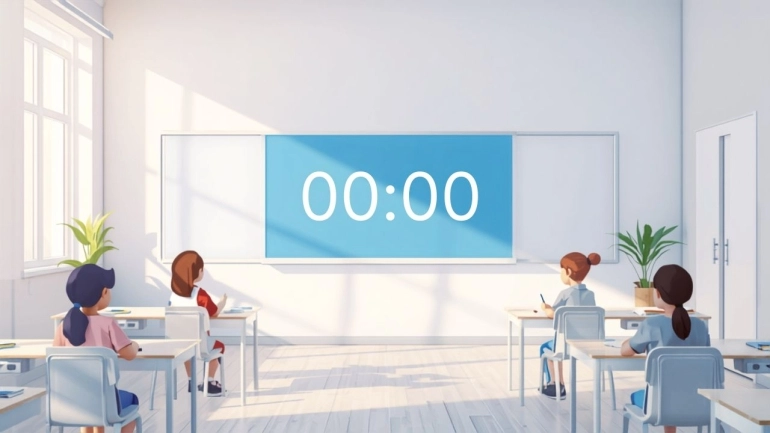
Help students start, stay focused, and finish classroom tasks with clearer time routines.
When Students Do Not Know How Long A Task Should Take
A teacher asks students to write a short response after reading a passage. The instruction sounds simple: write five clear sentences and use one detail from the text. Some students begin right away. Some stare at the page because they are unsure how much is expected. A few students spend most of the time choosing a pencil, talking quietly, or asking whether the answer has to be long.
The problem is not always effort. Many students struggle when classroom time feels open-ended. If a task has no visible time limit, students may not know whether to work quickly, carefully, briefly, or deeply. A ten-minute task can feel endless to one student and too short to another. The teacher may explain the time once, but in a busy classroom, that instruction is easy to miss.
A classroom timer gives students a simple visual anchor. It shows how much time they have, how quickly the task is moving, and when they need to shift from starting to finishing. For students who find transitions difficult, the timer can reduce surprise. For students who rush, it can remind them that careful work is expected. For students who delay, it makes the starting point clearer.
The Classroom Timer is useful when teachers want students to practice better focus routines without turning every minute into a verbal reminder. The timer works best when paired with clear instructions, realistic time limits, and a calm classroom routine. It is not about pressuring students. It is about making time easier to understand.
Use Case 1: Helping Students Begin Independent Work
Real situation: A teacher gives students twelve minutes to complete independent practice after a short lesson. The work is not too difficult, but several students lose the first few minutes before they actually begin.
Problem: Some students need a clear start signal. Without one, they may sharpen pencils, ask repeated questions, look around the room, or wait until the teacher comes near them. By the time they begin, the task feels rushed.
Solution: The teacher displays a twelve-minute classroom timer and gives one clear direction: start with question one, skip any question that blocks you, and circle it for help. The timer starts when students begin working, not while materials are still being passed out.
Result: Students have a visible reason to start. The teacher spends less time repeating “please begin” and more time checking student understanding. Students who usually delay can see that the work time is already moving.
Use Case 2: Building Better Reading Stamina
Real situation: A teacher wants students to read silently for fifteen minutes. Some students are comfortable with sustained reading, but others become restless after only a few minutes.
Problem: Students who struggle with reading stamina often feel unsure about how long the task will last. If the time feels invisible, they may give up early, ask to change books, or distract nearby classmates.
Solution: The teacher sets a fifteen-minute timer and explains the routine before reading begins: book open, voice off, stay with the same text, and mark one place to discuss later. For shorter attention spans, the teacher may begin with eight minutes and build toward longer sessions over time.
Result: Students can see the reading block as a manageable amount of time. The teacher can gradually increase stamina without making reading feel like a punishment. The timer gives students a finish line while still protecting quiet reading time.
Use Case 3: Keeping Writing Practice Moving
Real situation: Students are writing a paragraph in class. The teacher wants them to spend time planning, drafting, and checking, but many students either rush straight into writing or spend too long thinking.
Problem: Writing tasks often need smaller time parts. If students are given one large block, they may not divide it well. Some write without planning. Others plan for too long and never finish the draft.
Solution: The teacher breaks the writing task into timed sections: three minutes to plan, ten minutes to draft, and three minutes to reread and fix one sentence. The classroom timer is reset for each step. If students need practice material, a related Random Paragraph Generator can help provide sample text for editing or discussion.
Result: Students learn that writing has stages. The timer helps them move from thinking to drafting to checking. The teacher can support the process without needing to push each student individually.
Use Case 4: Making Group Work More Fair
Real situation: Students are working in groups to discuss a question and prepare a short answer. One student talks most of the time while others stay quiet. Some groups finish early, while others barely begin.
Problem: Group work becomes uneven when time is not divided clearly. Students may not know when to discuss, when to write, or when to choose a speaker. Stronger personalities can take over the whole task.
Solution: The teacher uses the timer to divide the task into clear rounds: two minutes for silent thinking, four minutes for group discussion, three minutes to write the answer, and one minute to choose a speaker. If groups need to be formed quickly, the teacher can use a Random Group Generator before starting the timer.
Result: More students participate because the task has structure. Quiet students get thinking time before discussion begins. Groups know when to move from talking to writing. The timer helps the teacher manage the room without stopping every group separately.
Use Case 5: Supporting Students During Transitions
Real situation: After a hands-on activity, students need to put materials away, return to seats, open notebooks, and prepare for the next part of the lesson.
Problem: Transitions can take longer than expected. Students may not understand whether they should clean, sit, talk, or wait. The teacher may repeat directions many times while the room becomes noisy.
Solution: The teacher sets a two-minute timer and gives a short checklist: return materials, clear the table, sit down, open notebooks. The teacher may display the checklist beside the timer so students can connect time with action.
Result: Students know what to do and how long they have. The transition becomes more concrete. Over time, the class can practice finishing the routine more calmly and consistently.
Use Case 6: Helping Students Pace Short Assessments
Real situation: Students are completing a short quiz or exit ticket. The teacher wants them to work carefully but finish before the end of class.
Problem: Some students rush because they feel nervous. Others spend too much time on the first question. Without a visible timer, students may not pace themselves well.
Solution: The teacher sets a realistic timer and explains how students should use the time. For example, on a ten-minute quiz, students might spend six minutes answering, two minutes checking, and two minutes finishing any skipped item.
Result: Students learn better pacing habits. The teacher can collect the work on time. The timer reduces repeated questions about how much time remains.
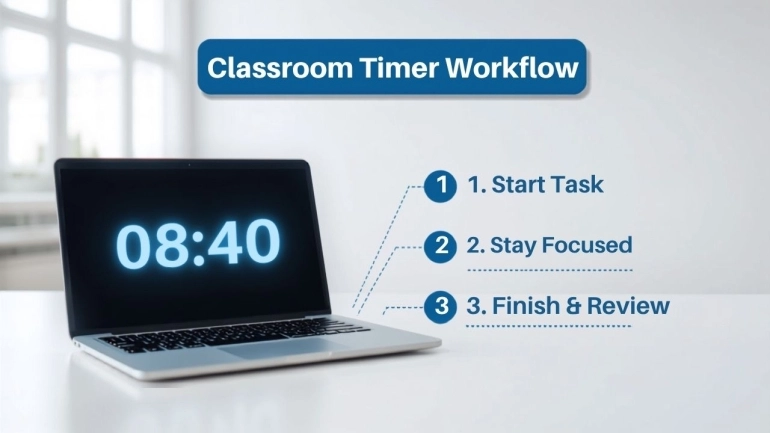
How This Fits Into A Real Workflow
- Choose the task. Decide whether the timer is for reading, writing, group work, cleanup, stations, quizzes, or transitions.
- Set a realistic time limit. Think about how long the task usually takes for average students, then allow support time if needed.
- Give clear directions first. Students should know what to do before the timer starts.
- Start the timer when work begins. Do not start it while students are still finding materials or listening to instructions.
- Use midpoint reminders carefully. A simple “halfway there” can help students pace themselves without interrupting the task.
- End with a clear next step. Tell students what to do when the timer finishes: stop, check, submit, rotate, clean, or discuss.
- Adjust after observing. If the timer was too short or too long, change it next time based on what actually happened.
Common Problems This Solves
- Students taking too long to begin work
- Repeated questions about how much time is left
- Transitions becoming noisy or unclear
- Reading time feeling endless for reluctant readers
- Writing tasks losing structure
- Group discussions drifting away from the task
- Students rushing through short quizzes
- Cleanup taking longer than planned
- Teachers repeating the same reminder too many times
- Students struggling to pace classroom assignments
Classroom Comparison
| Task | Using Classroom Timer | Without Classroom Timer |
|---|---|---|
| Independent work | Students see when to start and how long they have. | Some students delay until the teacher checks on them. |
| Reading practice | The reading block has a clear beginning and ending. | Students may ask repeatedly when reading will finish. |
| Writing practice | Planning, drafting, and checking can be timed separately. | Students may spend too long on one stage. |
| Group work | Discussion and writing time are easier to balance. | Groups may talk too long without producing work. |
| Transitions | Students know the time limit and expected actions. | The teacher may need to repeat directions several times. |
| Short quizzes | Students can pace answers and checking time. | Some rush while others lose track of the remaining time. |
Quality And Trust Tips
A classroom timer should support learning, not create panic. Teachers should choose time limits that match the task and the age of the students. A one-minute timer may work for putting away notebooks, but it is not fair for a thoughtful written response. A twenty-minute timer may work for reading, but younger students may need shorter blocks at first.
Make sure the timer is easy to see. If students cannot read it from the back of the room, it will not help much. If the timer is projected, check that it does not cover important instructions. Many teachers find that a timer works best beside a short task list.
Use sound carefully. A loud alarm may be useful during cleanup, but it may not be appropriate during reading, testing, or quiet writing. A visual countdown with a calm teacher cue is often enough.
Most importantly, keep teacher judgment involved. If a student has an accommodation, needs extra processing time, or is working through a difficult task, the timer should not override the support they need. The timer is a classroom guide, not a rule that replaces good teaching.
Privacy Reminder
A classroom timer does not require student names, faces, login details, grades, or school records. Teachers should avoid displaying private information on the same screen when projecting the timer. Before showing the timer to the class, close tabs or documents that include student data.
The tool only displays time. It does not remove private information from other files, browser tabs, screenshots, or documents. If the timer is used during online lessons or screen sharing, teachers should check what else is visible before students see the screen.
FAQ
Can students use a classroom timer for independent work?
Yes. A timer helps students understand how long they have and when they need to move from starting to finishing.
Is a classroom timer good for students who lose focus?
It can help because the task feels more concrete. Students can see time passing instead of depending only on verbal reminders.
How long should a focus timer be for students?
For younger students, five to ten minutes may be enough. Older students may work well with fifteen to twenty minute blocks, depending on the task.
Can teachers use this timer for group activities?
Yes. Teachers can time each stage of group work, including thinking, discussion, writing, and sharing.
Should the timer be visible the whole time?
Usually yes, especially for students who need help with pacing. For some assessments, the teacher may choose to show only periodic reminders.
Can a timer make students feel rushed?
Yes, if the time limit is too short or used as pressure. Teachers should set fair limits and explain that the timer is there to help pacing.
Can this help with classroom transitions?
Yes. A timer works well for cleanup, moving between stations, getting materials ready, and returning to seats.
What should happen when the timer ends?
Students should already know the next step. The teacher can ask them to stop, check work, submit, rotate, discuss, or clean up.
Final Thought
A classroom timer works because it makes time visible and shared. Students do not have to guess how long a task should take, and teachers do not have to repeat the same reminder again and again. When used with clear directions, it helps the class begin faster, stay focused longer, and finish with less confusion.
The best timer routines are calm and predictable. Set the task, start the timer, give students a fair amount of time, and follow through with the next step. Used this way, a classroom timer becomes part of the learning routine rather than a source of pressure.
 This article is about
Classroom Timer
Open the tool
This article is about
Classroom Timer
Open the tool