A practical study guide for estimating reading load, avoiding last-minute stress, and building better homework routines
A student opens a textbook chapter at 9:30 p.m. and assumes it will take ten minutes to read. The chapter looks short because it has headings, diagrams, and wide margins. Forty minutes later, the student is still reading, the homework questions are untouched, and the plan for the evening has already fallen apart.
This happens often because students judge reading by page count instead of reading load. A five-page handout with dense paragraphs may take longer than a ten-slide presentation. A short article with unfamiliar vocabulary may take more time than a longer story written in simple language.
Planning reading time is not about rushing. It is about knowing what the task really asks for before starting. When students can estimate how long a text may take, they can decide whether to read now, divide the work, take notes, or ask for clarification before the deadline gets too close.
Tools such as the Reading Time Calculator can support this habit, but the real skill is the routine around it: check the length, think about difficulty, add time for notes, and make a realistic plan.
Why Students Misjudge Reading Tasks
Students usually see the assignment first, not the hidden time inside it. A teacher may write, “Read the article and answer the questions.” That sounds simple until the student realizes the article is long, the vocabulary is new, and the questions require evidence from several paragraphs.
Page count can also be misleading. Font size, spacing, images, sidebars, and document layout change how much text appears on a page. A PDF with small text and narrow margins may contain far more words than a worksheet that looks similar in length.
Another problem is that reading for school is rarely only reading. Students may need to highlight, define words, take notes, compare ideas, answer questions, write a summary, or prepare for discussion. The first pass through the text is only one part of the job.
Good planning begins when students separate reading time from study time. If a passage takes 12 minutes to read, the full assignment may still need 25 or 30 minutes after notes and answers are included.
Start With The Real Task
Before estimating time, students should ask what the teacher actually wants them to do. Reading a chapter for general understanding is different from reading it to find quotes for an essay. Skimming a news article is different from studying a scientific explanation.
A useful first question is: “What will I need to produce after reading?” The answer may be a worksheet, class discussion, summary, quiz, essay plan, presentation slide, or personal notes.
If the output is small, such as three short questions, the student may need only a careful reading and a few notes. If the output is a paragraph response or essay outline, the student should plan extra time for selecting evidence and organizing ideas.
This small pause prevents a common mistake: treating every reading task as if it ends when the last sentence is finished.
Use Word Count Instead Of Page Count
Word count gives a clearer estimate than page count. A 600-word article and a 2,000-word chapter may both appear as a few pages depending on formatting, but they require different amounts of attention.
If the text is copied from a webpage or document, students can paste it into the Word Counter to check the exact length. If the task is mainly about planning how long reading may take, the Reading Time Calculator gives a direct estimate.
For example, a 1,200-word passage at 200 words per minute gives a base reading estimate of about six minutes. That does not mean the full assignment takes six minutes. It means the first reading may take around that long before notes, questions, or review.
Students should lower their expected speed for difficult material. A biology passage with new terms, a historical source with old-fashioned language, or a legal-style school policy may take longer than a familiar story.
Add Time For Thinking
Reading time is not the same as learning time. A student may read every word and still need to pause, reread, or connect ideas.
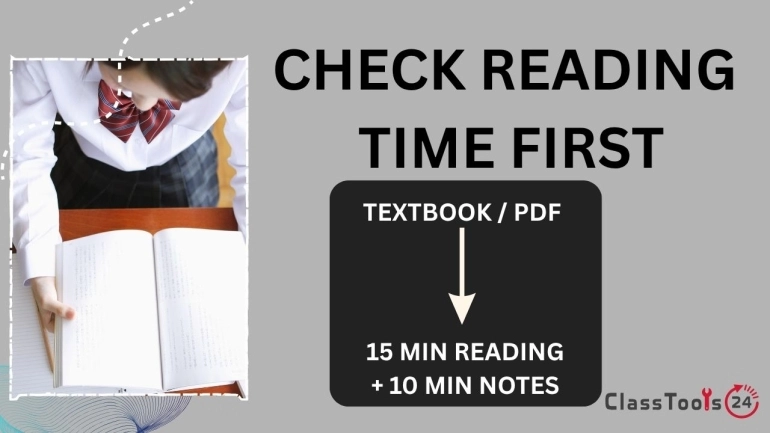
A practical rule is to add a second time block after the reading estimate. If the reading takes ten minutes, add another ten to fifteen minutes for notes, questions, or review. For difficult material, the thinking time may be longer than the reading time.
Students preparing for exams should be especially careful. Revision reading is not a race through pages. It often includes checking definitions, covering notes, testing memory, and solving practice questions.
A better plan is: read once for understanding, mark difficult sections, answer or summarize, then review the marked sections again. This routine takes longer but produces stronger recall.
Real Student Scenarios
1. Reading Before Class Discussion
Situation: A student must read an article before tomorrow’s class discussion.
Problem: The student waits until the morning and discovers that the article is longer than expected.
Better workflow: The student checks the reading estimate the night before, sees that the article needs about 14 minutes, and schedules 25 minutes to include notes.
Result: The student arrives with two useful points and one question instead of trying to skim during breakfast.
2. Planning Textbook Revision
Situation: A chapter is assigned for exam review.
Problem: The student reads the chapter once and assumes revision is complete, but cannot recall the key ideas later.
Better workflow: The student estimates the first reading, then adds separate time for summary notes and self-testing.
Result: Revision becomes active rather than passive. The student knows which sections still need work.
3. Reading A PDF Handout
Situation: A teacher shares a PDF handout through the learning platform.
Problem: The file looks short, but the text is dense and includes several diagrams.
Better workflow: The student checks the reading time, then adds extra time for diagram labels and written questions.
Result: The student avoids starting too late and has enough time to understand the visual information.
4. Preparing For A Presentation
Situation: A group project requires each student to read one source before creating slides.
Problem: One student chooses a long article without realizing it will take much more preparation time than the others.
Better workflow: Each group member checks reading length before assigning sources. Longer readings are divided or paired with shorter tasks.
Result: Workload becomes fairer, and the group can prepare slides with fewer last-minute problems.
5. Checking Essay Research
Situation: A student collects five sources for an essay.
Problem: The student plans to read them all in one evening but has not checked the total length.
Better workflow: The student estimates reading time for each source, then chooses two essential readings for tonight and saves the rest for another session.
Result: Research becomes more realistic, and the student reads carefully instead of rushing through every source.
How This Fits Into A Real Study Workflow
- Open the assignment instructions. Check whether the task requires reading only, notes, answers, summary, or discussion preparation.
- Find the text length. Copy the text or use the document when possible.
- Estimate reading time. Use the Reading Time Calculator for a quick planning estimate.
- Adjust for difficulty. Add more time for technical, unfamiliar, or exam-level material.
- Add thinking time. Include notes, answers, highlighting, or rereading.
- Divide long tasks. Break large readings into sections with short breaks.
- Prepare the output. Write the summary, answer the questions, or list discussion points.
- Review before submission. Check that the work answers the actual assignment, not only that the reading was completed.
Common Problems This Solves
- Starting a reading task too late.
- Judging reading load only by page count.
- Forgetting to allow time for notes.
- Underestimating dense textbook chapters.
- Rushing through sources before an essay.
- Arriving unprepared for class discussion.
- Choosing too much reading for one study session.
- Spending all available time reading and none answering.
- Planning group work unfairly.
- Feeling overwhelmed by long PDFs.
Reading With A Plan Compared With Guessing
| Study task | Planning reading time first | Guessing by page count |
|---|---|---|
| Homework reading | The student knows whether the task fits tonight. | The student may start too late. |
| Exam revision | Reading and review time can be separated. | The student may only read passively. |
| Essay research | Sources can be prioritized by time and value. | All sources may be treated as equal. |
| Group projects | Reading tasks can be divided more fairly. | One student may receive a much longer source. |
| Class discussion | There is time to prepare points and questions. | The student may skim without understanding. |
| Teacher handouts | Students can plan around the real workload. | A short-looking PDF may be underestimated. |
Practical Advice For Better Reading Sessions
Students should read with a purpose. Before starting, write one question the reading should answer. This keeps attention focused and makes notes easier to organize.
Long readings should be divided into sections. After each section, write a one-sentence summary. If the student cannot summarize it, that section probably needs another pass.
For difficult texts, slow down deliberately. Reading fast through unfamiliar material often creates the illusion of progress while leaving the main ideas unclear.
Students should also protect attention. Put away unrelated tabs, silence unnecessary notifications, and keep the assignment instructions visible. A 15-minute reading can easily become 40 minutes when interrupted repeatedly.
If the reading is part of a handout or study guide, students can use Text to PDF to create a cleaner copy after notes are organized. Teachers sharing links to reading materials can use the QR Code Generator when a printed worksheet needs quick access to an online source.
Privacy And File Awareness
Students should be careful with documents that contain names, grades, feedback, or private school information. If a tool is used only to estimate reading time, avoid uploading sensitive files when pasting a safe excerpt is enough.
Teachers should also check shared reading files before distributing them. A PDF can contain comments, student names, previous edits, or hidden document details that were not meant for the class.
Reading plans do not require personal information. Students can estimate time using the text itself without sharing login details, private messages, or confidential records.
Common Mistakes To Avoid
- Assuming every page takes the same time to read.
- Planning only for reading and not for answering.
- Starting long reading tasks at the end of the evening.
- Ignoring difficult vocabulary and diagrams.
- Reading without checking the assignment output.
- Trying to finish several long sources in one sitting.
- Using copied notes instead of writing a short summary.
- Uploading private school files unnecessarily.
- Confusing estimated reading time with full study time.
- Skipping review after the first reading.
Frequently Asked Questions
How can students estimate reading time?
Students can use word count and an average reading speed to estimate the first reading. They should add extra time for notes, questions, and difficult material.
Is page count a reliable way to plan reading?
Not always. Font size, margins, images, and layout can make two pages contain very different amounts of text.
How much reading can a student do in 30 minutes?
It depends on reading speed and difficulty. A simple article may fit easily, while dense textbook material may need more time for rereading and notes.
Should students read fast to save time?
Not when understanding matters. For school work, careful reading with notes is usually better than rushing through the text once.
How should students handle long chapters?
Divide the chapter into sections, estimate each part, take short notes, and review difficult sections separately.
Can reading time help with essay planning?
Yes. It helps students decide which sources to read first and how much time to reserve for notes and drafting.
Why does technical reading take longer?
Technical material often includes new vocabulary, diagrams, examples, and ideas that require pausing or rereading.
Can teachers use reading time estimates?
Yes. Teachers can check whether a passage fits the planned class time, homework load, or station activity.
Is estimated reading time exact?
No. It is a planning guide. Real reading time changes with difficulty, focus, prior knowledge, and the purpose of the task.
What should students do after reading?
They should complete the assignment output: answer questions, write a summary, prepare discussion points, or review key ideas.
Final Thought
Reading time planning gives students a clearer start. Instead of guessing, they can see whether a task fits the available time and what extra work the assignment requires.
The aim is not to turn reading into a race. The aim is to reduce last-minute stress and make space for understanding, notes, and better answers.
When students estimate reading load, divide longer tasks, and add time for thinking, school work becomes more manageable. A simple reading estimate can become the first step in a calmer, more reliable study routine.
 This article is about
Reading Time Calculator
Open the tool
This article is about
Reading Time Calculator
Open the tool