Study-friendly memory techniques students can use to remember lessons, vocabulary, formulas, facts, and concepts beyond the next quiz.
A student studies hard the night before a test, remembers enough to get through the quiz, and then forgets most of it a week later. Another student rereads the same page several times and feels familiar with the material, but cannot explain it without looking. This is frustrating because time was spent studying, yet the learning did not stay.
Long-term memory is not built by staring at notes for hours. It grows when students actively retrieve information, connect ideas, practise over time, explain concepts, and return to learning before it fades completely. Memory improves when the brain has to work with information instead of simply seeing it again.
Good memory techniques are useful for many school tasks: vocabulary, formulas, historical events, science processes, essay plans, definitions, diagrams, language learning, and exam revision. The key is choosing strategies that make the brain recall, organize, and apply information.
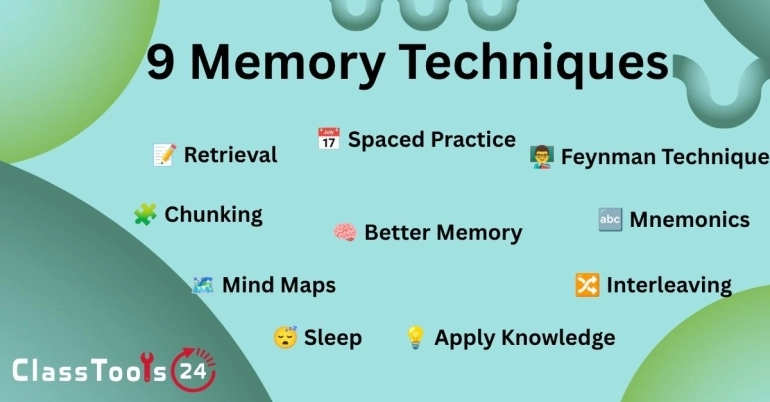
These nine memory techniques are practical enough for students to use during normal school weeks. They do not require expensive apps or complicated systems. They require consistency, attention, and smarter review habits.
Why Students Forget What They Study
Forgetting is normal. The brain does not keep everything with equal strength. Information that is only seen once, copied passively, or reviewed at the last minute is more likely to fade. This does not mean the student is incapable. It means the study method may not be giving the brain enough reasons to keep the information.
Students often mistake recognition for memory. When they reread notes, the information looks familiar, so they feel prepared. But recognition is easier than recall. A test usually asks students to remember, explain, solve, compare, or apply. That requires stronger memory.
Long-term retention improves when students revisit information at intervals, test themselves, make connections, and use the information in different ways. The following techniques help with exactly that.
1. Spaced Practice
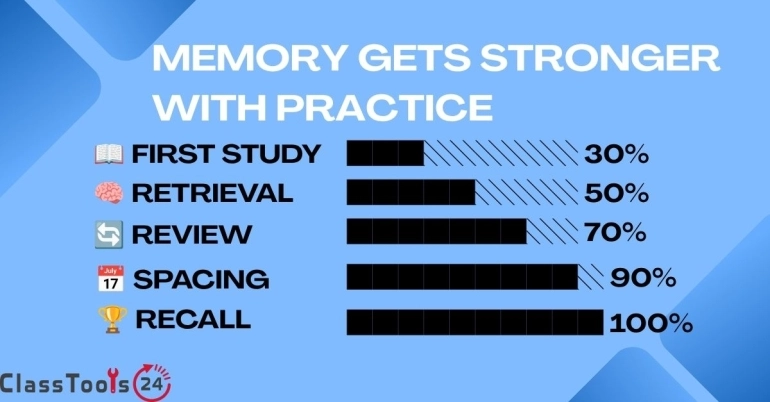
Spaced practice means studying information several times over days or weeks instead of cramming it all at once. Short, repeated review sessions build stronger memory than one long session the night before a test.
For example, instead of studying science vocabulary for two hours on Thursday night, review for 15 minutes on Monday, 15 minutes on Wednesday, 20 minutes on Friday, and 10 minutes before the quiz. Each return strengthens memory.
Spaced practice works because the brain has to retrieve information after some forgetting has begun. That effort makes the memory more durable. If review happens too soon, it may feel easy but not build as much strength. If review happens too late, students may need to relearn everything. The best timing is somewhere in between.
2. Retrieval Practice
Retrieval practice means trying to remember information without looking first. This is one of the most effective study habits. Instead of rereading a definition, cover it and try to say it. Instead of looking at solved math examples, try a problem first. Instead of reviewing a diagram, draw it from memory.
Retrieval can feel harder than rereading, but that is why it works. The brain strengthens memory when it pulls information out — writing the answer out by hand rather than typing it adds an extra layer of this effect, as covered in the cognitive benefits of writing by hand.
Simple retrieval practice ideas:
- Close the book and write everything remembered about the topic.
- Use flashcards and answer before flipping the card.
- Cover notes and explain the concept aloud.
- Draw a diagram from memory, then check it.
- Answer old quiz questions without notes.
- Write three possible test questions and answer them.
Students should check answers after retrieval. Mistakes are useful if corrected quickly. They show what needs more review.
3. The Feynman Technique
The Feynman Technique is simple: explain the idea in plain language as if teaching it to someone younger. If the explanation becomes confusing, that shows where understanding is weak.
For example, a student studying photosynthesis might say, “Plants use sunlight, water, and carbon dioxide to make food. Oxygen is released during the process.” If the student cannot explain where water or carbon dioxide fits, they know what to review.
This technique works because it exposes fake understanding. A student may recognize words in notes but struggle to explain them. Teaching forces clarity.
To use it:
- Choose one concept.
- Explain it in simple words without notes.
- Notice where the explanation breaks down.
- Return to the notes or textbook.
- Explain again more clearly.
4. Chunking
Chunking means grouping information into smaller, meaningful parts. The brain handles organized groups better than long random lists.
For example, a student learning a long list of vocabulary words can group them by theme, prefix, meaning, or usage. A student learning historical events can group them by causes, key events, and effects. A student learning formulas can group them by topic or problem type.
Chunking reduces overload. Instead of trying to remember twelve separate facts, the student remembers three groups with four items each.
Good chunks should make sense. Random grouping may not help much. The best chunks show relationships between ideas.
5. Mnemonics
Mnemonics are memory aids. They can be acronyms, phrases, rhymes, images, or patterns that help students remember information.
For example, students may use a phrase to remember the order of planets, a rhyme for spelling, or an acronym for steps in a process. Mnemonics are especially useful for ordered lists, vocabulary, formulas, classification systems, and facts that are hard to connect naturally.
However, mnemonics should not replace understanding. Remembering a phrase is helpful, but students also need to know what the information means. A mnemonic is a doorway, not the whole lesson.
Students can create their own mnemonics because personal memory aids are often easier to remember than ones copied from someone else.
6. Visual Mapping
Visual mapping helps students see how ideas connect. This can include mind maps, concept maps, flowcharts, timelines, diagrams, or labeled sketches. Visual organization is especially useful when information has relationships, sequences, causes, or categories.
For example, a concept map about ecosystems might connect producers, consumers, decomposers, food chains, energy flow, and habitats. A timeline can help with history. A flowchart can help with a science process. A labeled diagram can help with anatomy or geography.
The value is not in making the map pretty. The value is in deciding where ideas belong and how they connect. That decision-making strengthens memory.
7. Interleaving
Interleaving means mixing related types of practice instead of doing one type over and over. For example, instead of solving ten identical math problems, students practise a mix of problem types. Instead of reviewing only one grammar rule, they compare several rules and decide which one applies.
This technique helps students learn when to use a skill, not just how to repeat it. It may feel harder at first because the brain must choose the correct method. That difficulty builds better long-term learning.
Interleaving works well for math, science problem-solving, grammar, vocabulary, exam revision, and any subject where students must choose between similar concepts.
Use it after learning the basics. If a student has not learned the skill yet, blocked practice may be needed first. Once the basics are familiar, mixing practice becomes more useful.
8. Sleep And Review Timing
Memory is affected by sleep. Students often treat sleep as separate from studying, but tired brains do not learn or recall as well. Staying up late to cram may help in the short term, but it can hurt focus, mood, and memory the next day.
A better habit is to review earlier and sleep properly before the test. A short review before bedtime can be useful, but it should not become a long stressful session that cuts sleep.
Students can also use brief morning review. After sleeping, spend five to ten minutes recalling key ideas, formulas, or vocabulary. This works better than panicked rereading because it activates memory before class or the exam.
9. Apply The Information
Information stays longer when students use it. Applying knowledge means doing something with it: solve a problem, write an explanation, compare two ideas, teach a classmate, create an example, answer a practice question, or connect it to real life.
For example, learning a grammar rule becomes stronger when a student writes original sentences. Learning a science concept becomes stronger when the student explains a real example. Learning a history cause becomes stronger when the student uses it in an argument.
Application turns memory into understanding. It also prepares students for tests that ask more than simple recall.
A Simple Weekly Memory Routine
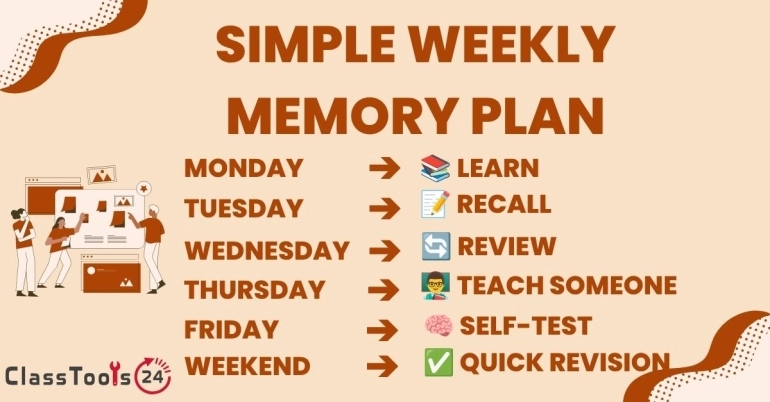
Students do not need to use every technique every day. A simple routine is easier to keep:
- After class, spend five minutes writing what you remember without notes.
- Check notes and correct missing or wrong ideas.
- Create three questions from the lesson.
- Review the questions two days later.
- At the end of the week, make a short concept map or summary.
- Before a test, practise mixed questions instead of only rereading.
This routine combines retrieval, spacing, questioning, visual mapping, and interleaving. It is short enough for normal school weeks and stronger than last-minute cramming.
Common Memory Mistakes
One mistake is rereading too much. Rereading can be useful once, but if it is the main study method, students may feel prepared without being able to recall the information.
Another mistake is highlighting everything. Highlighting works only when students choose the most important ideas. A page that is mostly highlighted is no longer organized.
Students also sometimes make flashcards but use them passively. Looking at the answer too quickly weakens the benefit. Try to answer first, then check.
Another common mistake is studying only in one order. If students always review vocabulary in the same sequence, they may remember the order more than the meaning. Shuffle cards, mix questions, and practise different examples.
How To Know If A Memory Technique Is Working
A memory technique is working if you can recall the information later without looking, explain it in your own words, use it in a new question, or connect it to another topic. Feeling familiar is not enough.
Test yourself honestly. Cover the notes. Close the book. Try the problem. Draw the diagram. Explain the concept. The moment before checking is where memory grows.
Final Thought
Long-term retention is built through active study, not last-minute pressure. Students remember more when they space practice, retrieve information, explain ideas simply, organize material into chunks, use visuals, mix practice, sleep well, and apply what they learn.
The best memory technique is the one a student will actually use. Start with one habit, such as retrieval practice or spaced review. Once it becomes normal, add another. Over time, studying becomes less about cramming and more about building knowledge that stays.