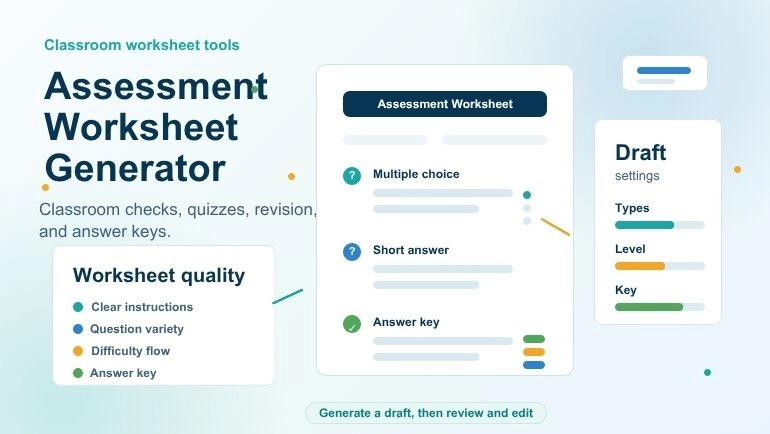
Un guide pratique pour concevoir des fiches d'évaluation plus claires qui vérifient la compréhension, soutiennent la révision, et font gagner du temps de préparation aux enseignants.
Comment préparer de meilleures fiches d'évaluation
Les fiches d'évaluation comptent parmi les moyens les plus simples de vérifier ce que les élèves ont retenu après un cours, une lecture, une séance de révision ou le bilan d'une séquence. Une fiche bien construite ne sert pas seulement à occuper le temps : elle montre où les élèves sont sûrs d'eux, où ils se trompent et ce qu'il faut reprendre avant que la classe aille plus loin.
Le matériau de départ, beaucoup d'enseignants l'ont déjà : notes de cours, pages du manuel, textes de lecture, synthèses de chapitre, polycopiés. Le plus dur est de transformer ce matériau en questions utiles. Une bonne fiche d'évaluation réclame les bons types de questions, des consignes claires, une difficulté équitable, assez de variété et un corrigé qui accélère la correction.
C'est là qu'un générateur de fiches d'évaluation peut rendre service. Au lieu de partir de la page blanche, l'enseignant colle ou importe son contenu de départ et obtient un brouillon de fiche qu'il peut relire, corriger, imprimer, partager ou réutiliser pour les révisions. L'objectif n'est pas de remplacer le jugement de l'enseignant : il est d'économiser du temps sur le premier jet pour que l'enseignant se concentre sur la qualité.
Pourquoi les fiches d'évaluation gardent leur utilité
Le numérique a changé la façon de partager des ressources, mais les fiches restent utiles parce qu'elles donnent aux élèves une tâche nette. Une fiche peut s'imprimer, se partager sous forme de document, s'utiliser en classe, se donner en devoir ou servir d'activité de révision rapide avant un contrôle.
Les fiches rendent aussi le raisonnement visible. Quand les élèves répondent sur papier ou dans un document, l'enseignant voit apparaître des régularités. Si beaucoup se trompent sur la même question, le problème vient peut-être de la notion, pas des élèves. Si seuls quelques-uns butent sur une partie, l'enseignant peut cibler son soutien. La revue spécialisée Edutopia fait une remarque voisine dans son panorama de techniques d'évaluation formative : des vérifications rapides et sans enjeu de note donnent aux enseignants une image immédiate du raisonnement des élèves, sans attendre une épreuve décisive.
Une fiche est particulièrement efficace quand elle se rattache à un objectif d'apprentissage clair. Ce ne doit pas être une série de questions prises au hasard : elle doit aider à répondre à une question importante, à savoir ce que les élèves devraient connaître ou savoir faire au terme de ce cours.
Ce qui fait une bonne fiche d'évaluation
Une bonne fiche d'évaluation est claire, ciblée et équitable. Les élèves doivent comprendre ce qu'il faut faire sans explication répétée. Les questions doivent correspondre au contenu du cours et au niveau attendu. Et il faut assez de variété pour vérifier autre chose que la mémoire.
- Des consignes claires : les élèves doivent savoir exactement comment répondre dans chaque partie.
- Des types de questions équilibrés : alternez restitution, compréhension, application et explication brève.
- Une bonne progression de difficulté : commencez par les questions les plus faciles, puis allez vers le raisonnement plus poussé.
- Une mise en page lisible : les questions doivent disposer d'assez d'espace et ne pas paraître tassées.
- Un corrigé : l'enseignant doit pouvoir vérifier les réponses rapidement.
- Un lien avec le cours : chaque question doit porter sur la notion évaluée.
Les difficultés courantes de la préparation
Les enseignants préparent souvent leurs fiches dans l'urgence. Le cours peut être prêt, mais l'activité d'évaluation reste à construire. Écrire assez de questions, peser les formulations, inventer les propositions de réponse, préparer les questions ouvertes et rédiger le corrigé prend beaucoup de temps.
Autre difficulté fréquente : la répétition. Il est facile d'écrire plusieurs questions qui vérifient le même petit détail et laissent de côté l'idée d'ensemble. Les élèves terminent la fiche, mais l'enseignant n'obtient pas une image complète de leur compréhension.
Certaines fiches sont aussi trop faciles ou trop difficiles pour la classe. Si chaque question ne demande que de restituer, la fiche ne révèle pas l'apprentissage en profondeur. Si chaque question est ardue, les élèves les plus fragiles renoncent avant que l'enseignant puisse voir ce qu'ils savent vraiment.
En quoi un générateur de fiches d'évaluation aide
Un générateur de fiches d'évaluation transforme un contenu existant en un ensemble structuré de questions. À partir du même texte de départ, on peut obtenir des questions à choix multiple, des exercices à compléter, des questions ouvertes brèves et le corrigé. On gagne du temps et on obtient un brouillon exploitable.
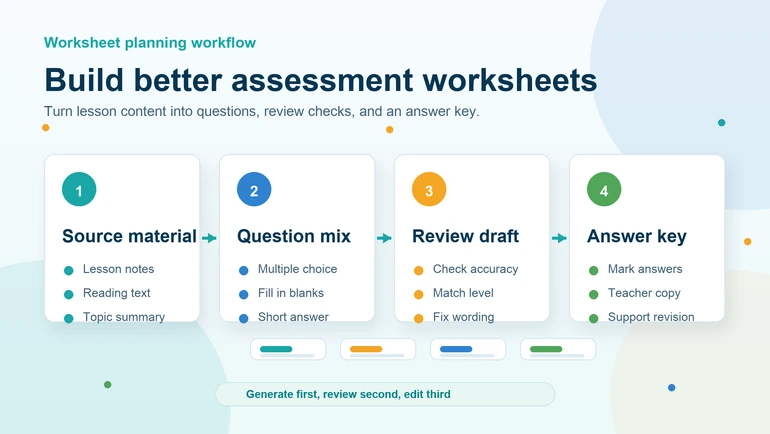
La meilleure démarche est simple : générer d'abord, relire ensuite, corriger enfin. La fiche produite ne doit pas être acceptée les yeux fermés. Mieux vaut vérifier l'exactitude, retirer les questions faibles, ajuster la difficulté et s'assurer que la fiche correspond à l'objectif de la classe.
Si l'enseignant veut d'autres idées de questions sur le même sujet, le Générateur de questions peut aussi aider à construire des exercices, des amorces de discussion et des vérifications de révision.
Quand utiliser une fiche d'évaluation
Les fiches d'évaluation servent à différents moments de l'apprentissage. Il n'y a pas à les réserver aux contrôles : une fiche courte peut aider avant, pendant ou après un cours.
| Moment de la classe | Rôle de la fiche | Type de questions le mieux adapté |
|---|---|---|
| Avant un cours | Vérifier les connaissances antérieures | Réponses brèves, vocabulaire, restitution simple |
| Pendant un cours | Vérifier la compréhension en cours de route | Textes à compléter, réponses éclair, vérifications de notion |
| Après un cours | Mesurer ce que les élèves ont appris | Types de questions mêlés, avec corrigé |
| Avant un contrôle | Soutenir la révision | Questions de révision et explications brèves |
| Devoirs | S'entraîner en autonomie | Consignes nettes, avec assez de place pour répondre |
La démarche pas à pas pour de meilleures fiches
- Choisissez le matériau de départ : des notes, un texte de lecture, du contenu de manuel ou la synthèse d'un cours.
- Définissez l'objectif : décidez ce que les élèves devront montrer à la fin de la fiche.
- Choisissez les types de questions : choix multiple, texte à compléter, réponse brève, ou un mélange.
- Générez un brouillon : servez-vous du générateur de fiches pour obtenir la première version.
- Vérifiez l'exactitude : contrôlez que chaque réponse est juste et que chaque question correspond au contenu.
- Ajustez la difficulté : retirez les questions trop vagues, trop faciles ou trop éloignées du cours.
- Améliorez la mise en page : assurez-vous que les élèves ont assez de place et que la fiche se lit bien.
- Servez-vous du corrigé : gardez-le pour la correction, la révision ou l'autoévaluation.
Choisir les bons types de questions
Les questions à choix multiple
Les questions à choix multiple se corrigent vite. Elles conviennent bien au vocabulaire, aux définitions, aux faits et à la reconnaissance de notions. Une bonne question à choix multiple comporte une seule réponse clairement juste et des propositions fausses crédibles. Des propositions faibles rendent la question trop facile.
Les textes à compléter
Les textes à compléter aident les élèves à retrouver des termes clés, des noms, des dates, des formules ou de courtes expressions. Ils sont utiles quand le cours contient du vocabulaire important ou des notions qu'il faut connaître avec précision.
Les questions à réponse brève
Les questions à réponse brève se prêtent mieux à l'explication. Elles montrent si les élèves savent relier des idées avec leurs propres mots. Elles servent à vérifier la compréhension au-delà de la mémorisation.
Les fiches mixtes
Une fiche mixte donne souvent l'image la plus juste de l'apprentissage. Elle peut s'ouvrir sur des questions simples, puis glisser vers l'explication et l'application, ce qui permet aux élèves de s'échauffer avant le raisonnement plus exigeant.
Comment ajuster la difficulté au niveau des élèves
Un même sujet s'évalue différemment selon le niveau de la classe. Les plus jeunes ont besoin de formulations plus courtes et de questions directes. Les plus grands sont prêts pour l'explication, la comparaison, le recours aux preuves et l'application. Des apprenants avancés ou en formation professionnelle peuvent aborder des questions construites sur des cas concrets.
L'enseignant devrait toujours relire la fiche produite avec les yeux de sa classe. Si les élèves découvrent le sujet, mieux vaut garder la première partie simple. S'ils ont déjà travaillé les bases, il vaut la peine d'ajouter des questions qui demandent d'expliquer pourquoi, de comparer des idées ou d'appliquer la notion à un exemple nouveau.
Utiliser les fiches pour réviser
Les fiches d'évaluation ne servent pas qu'à noter : elles peuvent aussi soutenir la révision. Une fiche accompagnée de son corrigé devient une activité d'autovérification. Les élèves répondent d'abord, comparent ensuite avec le corrigé et repèrent les parties à revoir.
Pour les lectures plus longues, les élèves peuvent d'abord passer par le résumé IA pour les élèves afin d'obtenir des notes d'étude plus claires. Puis l'enseignant ou l'élève transforme ce même matériau en questions d'évaluation. Cela dessine un parcours de travail utile : lire, résumer, s'entraîner, revoir.
Comment relire une fiche produite par l'IA
Une fiche produite par l'IA doit toujours être relue avant usage. Même quand la structure aide, l'enseignant doit contrôler les faits, les formulations, les propositions de réponse et la cohérence avec l'objectif du cours. Une question peut être grammaticalement correcte et rester inutile pour la classe.
- Supprimez les questions qui ne correspondent pas au cours.
- Réécrivez les formulations confuses.
- Vérifiez que les propositions de réponse sont équitables.
- Assurez-vous que le corrigé est juste.
- Ajoutez vos propres questions sur les notions importantes.
- Adaptez le niveau de lecture à la classe.
Des usages en classe
Le billet de sortie
L'enseignant peut tirer cinq questions brèves du cours et les utiliser comme billet de sortie. Cela donne un aperçu rapide de la compréhension avant la séance suivante.
L'entraînement à la maison
Une fiche peut devenir un devoir ciblé. Les élèves s'entraînent sur le même sujet sans avoir besoin d'un travail long.
La révision avant un contrôle
Avant un contrôle, les élèves peuvent remplir une fiche qui mêle vocabulaire, faits essentiels et questions d'explication. Cela les aide à repérer leurs points faibles.
La vérification de lecture
Après une lecture donnée, une fiche permet de vérifier si les élèves ont saisi les idées principales, et pas seulement s'ils sont allés jusqu'au bout.
L'activité pour un remplaçant
Une fiche claire, avec ses consignes et son corrigé, permet à un remplaçant de mener une activité ciblée quand l'enseignant habituel est absent.
Conseils pour les fiches à imprimer
- Placez des consignes brèves en haut de la feuille.
- Laissez assez d'espace entre les questions.
- Regroupez les types de questions semblables.
- Donnez un intertitre à chaque partie.
- Gardez les propositions de réponse alignées et lisibles.
- Prévoyez le nom, la date et la classe de l'élève si besoin.
- Imprimez le corrigé séparément de l'exemplaire des élèves.
Conseils pour les fiches numériques
Si la fiche doit être partagée en version numérique, précisez aux élèves s'ils doivent saisir leurs réponses, l'imprimer ou la remplir dans un autre document. Une fiche numérique doit rester propre et facile à suivre. Évitez les questions interminables, les mises en page encombrées et les consignes floues.
Si la fiche renvoie à une ressource en ligne, l'enseignant peut en créer une version à scanner avec le Générateur de code QR. Cela fonctionne bien pour des vidéos, des pages de lecture, des formulaires ou des documents d'appui.
Confidentialité et usage responsable
Les enseignants devraient éviter d'envoyer dans un outil en ligne des dossiers scolaires d'élèves, des notes, des données identifiantes ou des documents confidentiels de l'établissement, sauf s'ils ont le droit de traiter ces informations. Le matériau de départ doit porter sur le contenu du cours, pas sur des données privées.
Les élèves aussi doivent être guidés vers un usage responsable de ces outils. L'objectif est de s'entraîner et de comprendre, pas de recopier des réponses sans réfléchir. Le corrigé doit soutenir la relecture, non remplacer l'effort.
Questions fréquentes
Qu'est-ce qu'une fiche d'évaluation ?
C'est un ensemble de questions conçues pour vérifier ce que les élèves ont compris d'un sujet, d'un cours, d'une lecture ou d'une compétence.
L'IA peut-elle créer une fiche complète ?
L'IA peut produire un brouillon solide, avec questions et réponses, mais les enseignants doivent le relire et le corriger avant de l'utiliser en classe.
Quels types de questions fonctionnent le mieux ?
Un mélange, en général. Le choix multiple vérifie la reconnaissance, le texte à compléter la restitution, la réponse brève la compréhension.
Faut-il toujours noter les fiches ?
Non. Elles peuvent servir à s'entraîner, à réviser, de billet de sortie, de devoir, de vérification de lecture ou d'évaluation informelle.
Les fiches aident-elles à réviser un examen ?
Oui. Une fiche aux questions variées accompagnée d'un corrigé permet aux élèves de se tester avant l'épreuve.
Quelle longueur doit avoir une fiche ?
Cela dépend de l'objectif. Une vérification rapide peut tenir en cinq questions. Une fiche de révision complète peut demander plusieurs parties et des types de questions mêlés.
Conclusion
Les fiches d'évaluation permettent aux enseignants de voir ce que les élèves comprennent et ce qui demande encore du soutien. Une bonne fiche est claire, ciblée, équitable et rattachée à l'objectif du cours. Un générateur de fiches d'évaluation fait gagner du temps de préparation, puisqu'il tire un premier brouillon structuré du contenu d'un cours, de notes ou de documents. L'enseignant peut ensuite le relire, le corriger et l'améliorer pour qu'il convienne à sa classe. Bien employé, cela devient un outil concret pour vérifier la compréhension, soutenir la révision et rendre l'évaluation en classe plus facile à mener.
 Cet article porte sur
Générateur d'évaluations et de sujets d'examen
Ouvrir l'outil
Cet article porte sur
Générateur d'évaluations et de sujets d'examen
Ouvrir l'outil