Practical use cases for teachers, students, gamers, and groups who need fair random dice rolls online.
When a simple dice is missing
A teacher starts a math activity and suddenly realizes there is no physical dice in the classroom. The students are ready, the lesson is planned, and the activity depends on random numbers. Without dice, the teacher may need to change the activity or explain the idea only on the board. That makes the lesson less exciting because students cannot see randomness happening in front of them. The same problem happens when friends want to play a board game but cannot find dice anywhere. A small missing object can stop a whole learning activity or game.
The Dice solves this problem by giving a fast digital replacement for physical dice. It lets users roll one dice or multiple dice online and see random results instantly. Each dice roll produces a number from 1 to 6, and multiple dice can be added together for games or math practice. For example, a roll may show Dice 1: 4, Dice 2: 2, and Total: 6. This makes the tool useful for classrooms, online lessons, board games, decision making, and group activities. It keeps activities moving without needing any physical object.
What is a dice tool
A Dice tool is an online utility that simulates rolling real dice on a screen. Instead of holding a cube and throwing it by hand, the user clicks a button and receives a random number. The result is fast, simple, and fair for normal classroom and game use. The tool can be used on mobile, tablet, laptop, or desktop, so it works well in many situations. Teachers can use it during lessons, students can use it during homework, and gamers can use it during board games. It gives the same basic purpose as physical dice but with more convenience.
This tool is especially helpful when more than one dice is needed. Some games and probability exercises require two dice, three dice, or more dice at the same time. Rolling multiple physical dice can be messy in a classroom because dice may fall under desks or get lost. The online Dice tool keeps everything visible and organized on the screen. It also shows results quickly, which helps teachers manage class time better. Students can focus on the concept instead of waiting for materials.
How random dice rolls work
Each dice roll gives a random number between 1 and 6. When one dice is rolled, there are six possible results, and each result has a chance of appearing. When two dice are rolled, the results can be combined to create totals such as 2, 5, 7, or 12. This is useful for teaching addition, probability, and outcome comparison. Students can record results and see how often each number appears. Over time, they begin to understand that random results are not controlled by guessing.
Randomness matters because it creates fairness and surprise. A student cannot choose the result, and a player cannot predict the next roll. This makes the Dice tool useful for fair games and unbiased decisions. The National Council of Teachers of Mathematics uses dice-based activities for exactly this reason: they give students repeated, hands-on trials for building real intuition about probability. For example, if six students want to choose presentation order, each student can be assigned a number. The dice roll can decide the order without argument. Everyone can see that the result came from chance rather than favoritism.
Use case 1: teachers making math classes interactive
Situation: A teacher is teaching probability, addition, or number games in class and wants students to participate actively. The teacher knows that students learn better when they can see examples, make predictions, and test results themselves. A normal lecture may explain the idea, but it may not keep every student involved. Some students understand faster when they see numbers changing in real time. The teacher needs a simple activity that works for the whole class. A dice roll is one of the easiest ways to bring randomness into a math lesson.
Problem: Students often lose interest when math is taught only through formulas and written examples. If the teacher only writes probability on the board, many students may memorize the answer without understanding the concept. Physical dice can help, but they may not be available for every student. They can also create noise, delays, or classroom management problems. In online classes, physical dice are even harder to use because students are not in the same room. The teacher needs a cleaner and more controlled method.
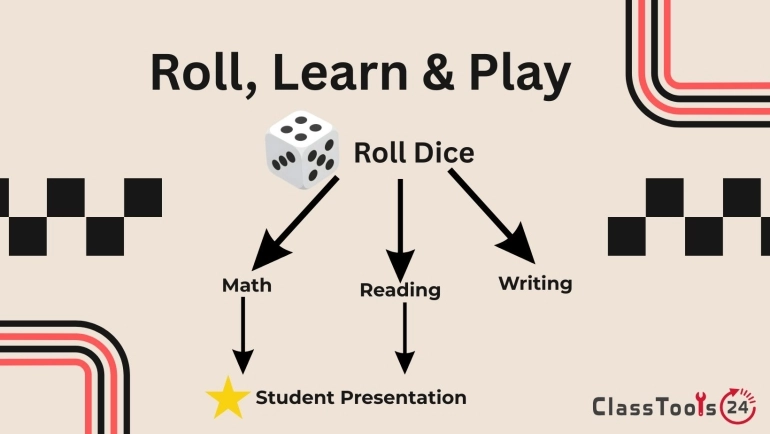
Solution: The teacher uses the Dice tool to roll virtual dice in front of the class. Students first predict the result, then the teacher rolls the dice and writes the result on the board. The class repeats the activity several times and records how often each number appears. For addition practice, the teacher rolls two dice and asks students to add both numbers quickly. For probability practice, the teacher asks which totals are more common when two dice are used. The tool turns a simple lesson into an activity where students watch, think, answer, and discuss.
Result: The class becomes more active because students are not only listening. They are predicting, counting, comparing, and explaining. The teacher can show that random results do not always match expectations in a small number of rolls. Students also learn that more trials can make patterns easier to study. This helps them understand probability in a natural way. The Dice tool makes the lesson faster, fairer, and more engaging.
Use case 2: students learning probability and math
Situation: A student is studying probability at home and has homework questions about dice outcomes. The textbook says that each dice has six sides, but the student wants to see how results actually appear. The student may need to practice questions about rolling one dice, rolling two dice, or finding totals. Without practice, the topic feels difficult and abstract. The student wants a simple way to experiment without asking a teacher every time. The Dice tool gives that practice immediately.
Problem: Probability can confuse students because it is about chance, not fixed answers. A student may think that if a dice shows six once, it should not show six again soon. Another student may think that every number must appear equally after only six rolls. These misunderstandings happen because students do not always test random events enough. Physical dice may not be available at home, and drawing examples on paper does not feel real. The student needs repeated practice with actual random results.
Solution: The student opens the Dice tool and starts rolling one dice many times. They write down each result and count how many times each number appears. After that, they roll two dice and calculate the total each time. They can compare totals such as 2, 7, and 12 to see how some totals appear more often than others. This step-by-step practice connects the formula with real observation. It also helps the student understand that randomness can create different results each time.
Result: The student becomes more confident because the concept is no longer only theoretical. They can see that each roll is independent and cannot be predicted. They also learn that probability becomes clearer when more trials are recorded. This improves problem solving for exams and classroom tasks. The Dice tool becomes a small learning lab for practicing math at home. It helps students turn confusing probability ideas into visible examples.
Use case 3: playing board games online
Situation: Friends are playing a board game at home or through a video call, but they do not have physical dice. The game depends on dice rolls to move pieces, decide turns, or create random outcomes. Everyone is ready to play, but the missing dice becomes a problem. Searching for dice wastes time and breaks the mood. In an online game night, one person may have dice while others do not. The group needs one fair method that everyone can accept.
Problem: Without dice, many board games cannot continue properly. Players may try to guess numbers, use paper slips, or ask someone else to choose a number, but those methods do not feel fair. A player may suspect that the result was chosen instead of randomly generated. This can create small arguments and reduce trust in the game. Board games are supposed to be fun, but unfair methods can make players lose interest. The group needs a quick and unbiased replacement.
Solution: The players use the Dice tool as a virtual dice roller. One player can share the screen, or each player can open the tool on their own device. When a turn comes, the player clicks roll and uses the displayed number in the game. If the game needs two dice, the tool can roll multiple dice and show the total. This keeps the game rules simple and clear. The digital roll works like physical dice but is easier to access.
Result: The board game continues without delay. Players can enjoy the game even when physical dice are missing. The random result keeps the game fair and exciting. The group does not need to stop, search for dice, or change the rules. The tool also works well for remote players because everyone can see or trust the digital result. This makes online and offline game sessions smoother.
Use case 4: random decision making
Situation: A group needs to make a small decision but cannot agree quickly. Students may need to choose who presents first, friends may need to decide which game to play, or a family may need to choose a simple task order. Everyone has a different preference, and discussion may take too long. The decision is not serious enough for a long debate, but it still needs to feel fair. A random method can save time. Dice are perfect for this type of situation.
Problem: When people choose manually, someone may feel ignored or treated unfairly. A group leader may accidentally pick a friend first, or a louder person may control the choice. This can create frustration, especially in classroom group work. Even small decisions can waste several minutes when no one agrees. If the decision method is not clear, people may question the result. A neutral tool is needed to remove bias.
Solution: The group assigns each option to a dice number. For example, number 1 may mean topic A, number 2 may mean topic B, and number 3 may mean topic C. If there are fewer than six options, unused numbers can mean roll again. The group rolls the online Dice tool and accepts the result. This method is simple, visible, and easy to explain. It turns a slow decision into a fair random choice.
Result: The decision is made quickly without argument. Everyone understands that the result came from chance, not from personal preference. The group can move forward with the task instead of wasting time. Teachers can use this method for classroom turns, students can use it for project choices, and friends can use it for games. The Dice tool makes small decisions easier and more peaceful. It supports fairness in a very practical way.
Use case 5: group assignments and activities
Situation: A teacher wants to divide students into groups for a class activity. The class may have many students, and the teacher wants the grouping process to be quick and fair. If the teacher chooses groups manually, some students may complain. If students choose their own groups, the same friends may always sit together. The teacher needs a method that feels neutral and organized. Dice can help create random group assignments.
Problem: Group work can become unfair when students always work with the same people. Some students may be left out, and some groups may become stronger than others. Manual grouping also takes time, especially in a busy classroom. The teacher may need to start the activity quickly and avoid arguments. In online learning, grouping can be even harder because students are not physically present. A random digital method makes the process easier.
Solution: The teacher uses the Dice tool (or a Random Group Generator for larger classes) to assign group numbers. For example, if there are six groups, each student rolls once and joins the group matching the dice result. If a group becomes full, the student can roll again. For smaller classes, the teacher can use the dice to choose activity roles such as speaker, writer, timer, or presenter. This keeps the process transparent. Students can see that the grouping is based on random chance.
Result: Groups are created faster and with fewer complaints. Students understand that the teacher is not choosing favorites. The activity begins sooner, and the classroom feels more organized. Random grouping also helps students work with different classmates, which improves teamwork. The Dice tool becomes useful not only for math but also for classroom management. It saves time while keeping the process fair.
Step by step guide
Using the Dice tool is simple enough for beginners. First, open the Dice tool in a browser on your phone, tablet, laptop, or desktop. Next, decide how many dice you need for your activity or game. If you need one random number from 1 to 6, roll one dice. If you need a total from multiple dice, select more dice and roll them together. Then read the results shown on the screen and use them in your lesson, game, or decision.
For classroom activities, it is helpful to explain the rule before rolling. Tell students what each result means so there is no confusion after the dice is rolled. For example, number 1 can mean group one, number 2 can mean group two, and number 3 can mean group three. In probability lessons, ask students to predict the result before rolling. After rolling, record the result and repeat the process several times. This creates a clear learning pattern that students can follow.
Benefits of the dice tool
The biggest benefit of the Dice tool is convenience. Users do not need to carry physical dice, search drawers, or borrow materials from someone else. The tool is available whenever a device and browser are available. It is also useful in online classes where physical dice cannot be shared. Teachers can display it on screen, and students can follow the results together. This makes it practical for both classroom and remote learning.
Another benefit is fairness. Random dice results help avoid bias in games, group work, and decision making. The tool also helps students understand probability through real examples. Instead of only reading about random outcomes, students can see them happen instantly. Gamers can continue board games without physical dice, and groups can make small decisions without long debate. This simple tool supports learning, fun, and fairness at the same time.
Common mistakes to avoid
One common mistake is thinking that a dice result can be predicted because of the previous roll. If a dice shows 6, the next roll is still random and can be 6 again. Each roll is independent, and the tool does not remember the last result in a way that controls the next one. This is an important idea for probability learning. Students should not expect perfect balance after only a few rolls. Randomness can create surprising results in short experiments.
Another mistake is not setting clear rules before using dice for decisions. If a group rolls first and decides the meaning later, people may argue about the result. The better method is to assign each number to an option before rolling. Teachers should also explain what happens if an unused number appears. For example, the rule can be to roll again. Clear rules make the Dice tool more useful and prevent confusion.
Pro tips for better activities
Teachers can make dice activities stronger by asking students to record results in a table. After ten, twenty, or fifty rolls, students can compare the results and discuss patterns. This helps them see the difference between expected probability and actual results. Students can also create graphs from dice results to connect math with data handling. For younger students, dice can be used for addition races and number recognition games. For older students, dice can introduce probability experiments and simulations.
Gamers can use the Dice tool more smoothly by keeping it open before the game starts. This avoids delays when a turn arrives. Groups can also decide who will roll and how the result will be shared. For online games, screen sharing can make the roll visible to everyone. For decision making, write down the options before rolling. These small habits make the tool more transparent and reliable.
Final thoughts on dice use cases
The Dice tool is simple, but its value is larger than it first appears. It can support classroom teaching, student practice, board games, group decisions, and activity planning. It gives random results instantly and removes the need for physical dice. Teachers can use it to make lessons more active, and students can use it to understand probability through practice. Gamers can use it when dice are missing, and groups can use it to make fair choices. A small digital dice roll can solve many everyday problems.
The most important thing to remember is that dice results are random and cannot be predicted. This randomness is what makes the tool fair and useful. When students see random results many times, they begin to understand chance in a practical way. When players use random rolls, games stay exciting and fair. When groups use dice for decisions, the process feels neutral. That is why an online Dice tool is helpful for learning, playing, and organizing activities.
For best results, use the Dice tool with a clear purpose. Decide whether you are using it for math, games, decisions, or group activities. Explain the rules before rolling, especially when other people are involved. Record results when learning probability, and use multiple dice when the activity needs combined outcomes. Keep the process simple so everyone understands what is happening. With the right approach, this tool becomes a reliable digital replacement for physical dice.
 This article is about
Virtual Dice Roller for Classroom Games and Activities
Open the tool
This article is about
Virtual Dice Roller for Classroom Games and Activities
Open the tool