Quick, calm, and realistic morning meeting ideas for elementary classrooms where every minute before the first lesson matters.
The first five minutes of an elementary classroom can decide the mood of the next hour. Students arrive with backpacks half open, breakfast still on their minds, playground stories ready to burst out, and sometimes a little worry they cannot explain yet. A teacher may be taking attendance, checking homework folders, answering a parent note, and helping one student find a pencil all at the same time.
Morning meetings are helpful, but many teachers hear the phrase and imagine a long circle time they simply cannot fit into the day. The truth is that a morning meeting does not have to take twenty minutes to be useful. A short, well-practiced five-minute routine can help students feel noticed, understand the tone of the day, and move into learning with fewer bumps.
For busy elementary teachers, the goal is not to add another heavy task. The goal is to create a small daily anchor. Students know what happens after they unpack. They know how to greet each other. They know there will be one quick question, one tiny classroom connection, or one shared focus before the academic work begins. That predictability is powerful, especially for younger learners.
These five-minute morning meeting ideas are built for real classrooms. They work when the copier is jammed, when lunch count is late, when a student is crying in the hallway, and when the day already feels full before the bell rings. Choose one idea at a time, teach it clearly, and repeat it until students can do it with very little help.
What A Five-Minute Morning Meeting Can Do
A short morning meeting gives students a gentle transition from arrival to learning. Many children need a moment to shift from home, bus, car line, breakfast club, or playground energy into classroom expectations. If that transition is ignored, it often shows up later as blurting, wandering, arguing, or slow starts.
Five minutes can also help a teacher notice the room. Who looks tired? Who is unusually quiet? Who is excited about something? Who may need a private check-in later? A quick class routine gives the teacher a small window into student mood without turning the morning into a counseling session.
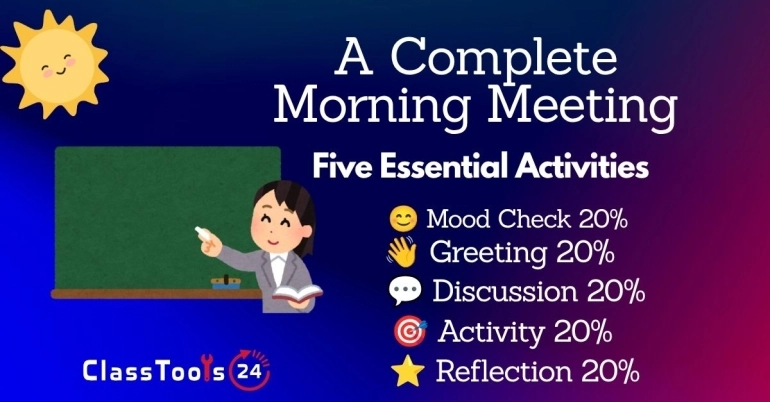
The best short meetings include three simple parts: a greeting, a connection, and a focus. The greeting helps students feel seen. The connection builds classroom community. The focus points students toward the learning day. Not every meeting needs all three parts every day, but keeping those ideas in mind helps the routine stay useful instead of becoming random.
How To Keep Morning Meetings To Five Minutes
The biggest challenge is time. A morning meeting can easily stretch if students tell long stories, if every child answers every question aloud, or if the teacher tries to solve every classroom issue in the moment. The solution is to make the routine tight and predictable.
Use a timer if needed. Give students sentence frames. Let students answer with thumbs, fingers, partner talk, sticky notes, or quick gestures instead of full speeches. Save longer discussions for another time. A five-minute morning meeting should feel complete, not rushed, but it should also respect the schedule.
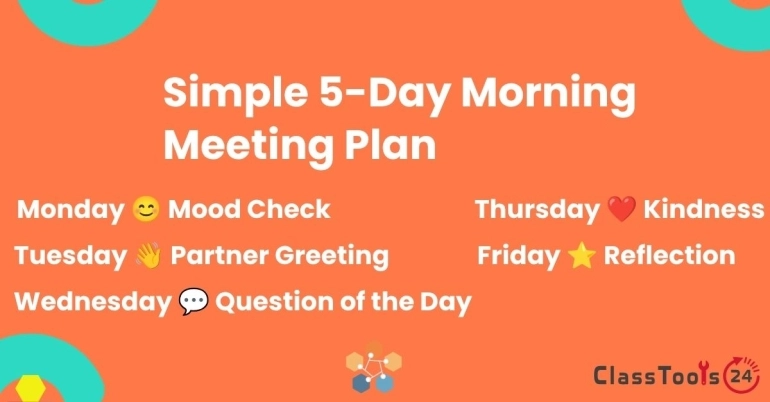
It also helps to use the same structure for a week. For example, every Monday can be a mood check, every Tuesday can be a partner greeting, every Wednesday can be a class question, every Thursday can be a kindness prompt, and every Friday can be a reflection. Students move faster when they know the pattern.
5-Minute Morning Meeting Ideas
1. One-Word Check-In
Ask students to choose one word that describes how they feel as they enter the day. They can say it aloud, whisper it to a partner, write it on a sticky note, or show it with a card. This gives students a simple way to name their mood without needing a long explanation.
2. Greeting Around The Room
Students turn to a nearby classmate and say good morning using the person’s name. The teacher models the first one: “Good morning, Amira. I’m glad you’re here.” This supports names, eye contact, and respectful tone without taking much time.
3. Question Of The Day
Write one light question on the board. Examples: Would you rather read outside or inside? What is one food you could eat every week? What helps you focus? Students answer with a quick partner share or by placing a sticky note under a choice.
4. Weather Mood
Students choose a weather word for their mood: sunny, cloudy, stormy, windy, foggy, or calm. This works well with younger students because it gives them language for feelings in a safe, indirect way.
5. Today I Need
Give students three choices: help, quiet, movement, encouragement, or challenge. They choose one silently with fingers or cards. The teacher gets a quick sense of what the class may need that morning.
6. Quick Class Compliment
Invite students to name one thing the class did well yesterday. Keep it specific: lined up calmly, helped a classmate, used math tools carefully, cleaned up quickly, or listened during reading. This helps students notice positive behavior.
7. Partner High-Five Or Wave
Students greet a partner with a wave, high-five, fist bump, or smile. Always give a no-touch option. The point is connection, not forcing physical contact.
8. Finish The Sentence
Use a sentence starter such as “Today I will try to...” or “One thing I am ready for is...” Students finish it with a partner. This sets a learning intention without becoming a long goal-setting lesson.
9. Class Breathing Reset
Lead three slow breaths. Ask students to put both feet on the floor, relax their shoulders, and breathe in through the nose and out slowly. This is helpful after a noisy arrival or rainy morning.
10. Mystery Number Greeting
Choose a number, such as three. Students greet three classmates before sitting. Keep the movement controlled by giving a clear path or time limit.
11. Turn And Teach
Ask students to teach a partner one tiny thing they remember from yesterday’s lesson. It might be a vocabulary word, a math step, or a reading strategy. This connects morning meeting to academics.
12. Kindness Target
Choose one kindness focus for the day: include someone, use polite words, help with materials, listen the first time, or thank a classmate. Keep it visible on the board.
13. Attendance With Feeling
Instead of only calling names, ask students to answer with one of three choices: ready, sleepy, or curious. Keep choices simple so attendance does not become slow.
14. Classroom Promise
Read one short class promise together: “We will listen, try, and help each other today.” Repeating a short statement can settle the room and remind students what kind of space they are building.
15. Object Of The Day
Hold up a classroom object, such as a pencil, book, ruler, or eraser. Ask students what it reminds them to do today. An eraser might remind them that mistakes are part of learning.
16. Silent Vote
Ask a question with two or three choices and let students vote silently. For example: Which read-aloud voice should I use later? Which review game should we play Friday? Students enjoy having small choices.
17. Name Chain
One student says good morning to another student by name. That student greets someone else. Continue for one minute. This is especially useful at the start of the year.
18. Today’s Word
Choose one word for the day, such as focus, courage, respect, revise, notice, or patience. Ask students to listen for that word or use it during the day.
19. Quick Movement Match
Call out simple movements: stretch up, tap shoulders, roll hands, stand tall, sit calmly. Students follow and then freeze ready for learning. This is useful for classes that need movement before sitting.
20. Rose And Thorn Lite
Students share one good thing or one tricky thing with a partner. Keep it optional and brief. The teacher can say, “Share only what feels okay for school.”
21. Table Team Check
Each table quickly checks that everyone has basic materials: pencil, notebook, folder, or device. This turns organization into teamwork instead of repeated teacher reminders.
22. Good News Minute
Give the class one minute for two or three students to share good news. Use a weekly rotation so the same students do not speak every day.
23. Learning Forecast
Preview the day in one sentence: “Today we will solve word problems, read about habitats, and practise using evidence.” Students feel calmer when they know what is coming.
24. Partner Prediction
Show a picture, word, or object connected to the lesson. Students predict what they will learn. This builds curiosity before instruction begins.
25. Gratitude Tap
Students tap their desk once for something they appreciate: a person, a place, a food, a book, or a skill. A few volunteers may share, but everyone participates quietly.
A Weekly Five-Minute Morning Meeting Plan
If planning a new activity every day feels like too much, use a simple weekly pattern. Repetition is not boring for elementary students when the prompts change slightly. In fact, repetition helps them feel secure and makes the routine faster.
| Day | Meeting Focus | Simple Activity |
|---|---|---|
| Monday | Settle and reconnect | One-word check-in |
| Tuesday | Build relationships | Partner greeting |
| Wednesday | Support learning | Turn and teach from yesterday |
| Thursday | Classroom culture | Kindness target |
| Friday | Reflect | Good news or class compliment |
This kind of routine saves teacher energy. You do not have to search for a new idea every morning. Students learn what to expect, and you can adjust the prompt based on the week’s lessons, classroom mood, or upcoming events.
Common Problems And Easy Fixes
If students talk too long, use sentence frames. Instead of “Tell your partner about your weekend,” try “One thing I did was...” or “One thing I am ready for is...” The frame keeps answers short and helps students who struggle to begin.
If the same students always speak, use partner talk before whole-class sharing. You can also choose volunteers by table, birthday month, number cards, or a rotating list. The goal is not to silence confident students, but to make room for quieter classmates.
If students get too silly during greetings, model the exact voice and body language you expect. Practise it once, then restart. Younger students often need to see the difference between playful and disruptive.
If the meeting feels disconnected from learning, add a quick academic bridge. Ask students to recall one word from yesterday, predict today’s topic, or name a strategy they will use. Morning meetings can support community and academics at the same time.
How This Helps Busy Teachers
A five-minute morning meeting can reduce repeated reminders later. Students who feel greeted may need less attention-seeking behavior. Students who know the day’s plan may ask fewer anxious questions. Students who practise listening in a short routine may transition more smoothly into partner work.
It also gives the teacher a calm starting point. Instead of beginning with corrections, missing supplies, and hurry, the class begins with a shared moment. That does not make every day perfect, but it gives the room a better first step.
For new teachers, morning meetings can also become a classroom management tool. The same expectations used in the meeting, such as listening, taking turns, facing the speaker, and responding kindly, can be referred to during the rest of the day.
Tips For Making It Work Long Term
- Keep the meeting short enough that you can actually do it daily.
- Use the same opening phrase so students recognize the routine.
- Give students low-pressure ways to participate.
- Use partner talk more often than whole-class sharing.
- Avoid questions that ask for private family or personal information.
- Connect the meeting to classroom values, not just entertainment.
- Change the prompt, not the entire routine, when you need variety.
Final Thought
Busy elementary teachers do not need a long morning meeting to build a warmer classroom. Five focused minutes can help students feel seen, understand the day, practise respectful communication, and move into learning with more confidence.
The best routine is the one you can repeat even on a messy morning. Start small. Use one greeting, one question, or one breathing reset. When students know that every day begins with a calm and predictable moment, the classroom starts to feel less rushed and more ready for learning.